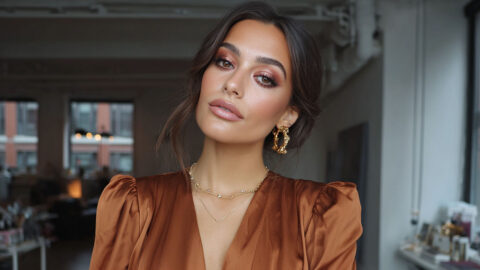
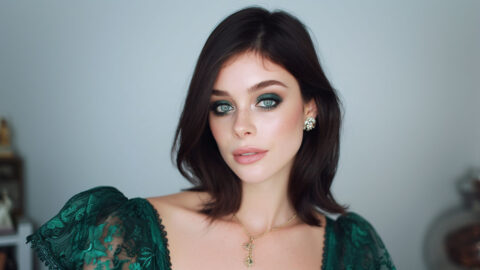
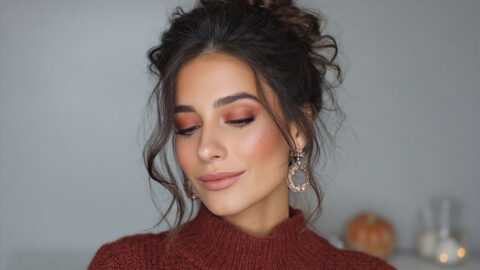
Warm neutrals like bronze, copper and champagne are the easiest makeup to wear with a blue dress, and a blue-red lip is the other reliable option. Which one you land on depends mostly on how deep the blue is and what your skin undertone does with it, with eye color nudging things from there.
The reason goes back to Michel-Eugène Chevreul’s 1839 treatise on simultaneous contrast (Pitois-Levrault). He found that contrasting colors strengthen each other’s luminosity, while similar colors weaken it.
That is why copper, coral and peach look sharper against blue fabric, and why blue shadow on a blue dress goes dull.
Should makeup match the blue dress or contrast with it?

Contrast it, but gently. Bronze, champagne and soft brown flatter nearly every blue without fighting the fabric.
Guides don’t agree on this, though. Some say to echo a navy dress with navy shadow. Jovani’s eyeshadow guide goes the other way and says to complement the outfit, because softly coordinated shades look more elegant than an exact color match.
The same split shows up among artists. Rose Inc’s Min Min Ma says to skip blue shadow on blue eyes since it is too much of the same tone. Makeup artist Jason Hoffman (Rose Inc) likes it as a monochromatic look, even though it does not make the eye color stand out.
In practice, people tend to pick from a short list of approaches.
- Complementing means warm shades opposite blue, like copper, coral and peach. It suits a face that should stand apart from the dress.
- Going neutral with taupe, gray, bronze or soft silver (Jovani) makes sense when the dress already carries the outfit.
Blue on blue is the remaining route. It works as a deliberate styling choice, as long as the lip stays quiet.
The color wheel explains the first approach. Adobe’s color guide lists orange as the complement of blue, and opposite colors placed side by side make each other look brighter (simultaneous contrast).
If the dress is bold, keep the face quiet. If it’s plain, you’ve got room to add color.
Lip color follows the same logic, and picking a lipstick shade to suit the outfit gets easier once the eyes are settled.
Makeup colors for each shade of blue

| Dress shade | Eyeshadow | Lip | Blush |
|---|---|---|---|
| Navy | Bronze, taupe, soft brown | Nude, red, plum | Rose or soft berry |
| Royal blue, cobalt | Silver, gunmetal, copper | Blue-red, berry, nude | Pink or peach |
| Powder blue | Peach, champagne, rose | Soft pink, coral | Peach or light pink |
| Teal | Copper, warm bronze | Coral, warm rose | Terracotta or apricot |
Navy is the forgiving one. It reads close to a neutral, so nude eyes with a stronger lip and a bronze smoky eye with a nude lip both work.
Pick the mouth after the eyes are done, and a guide to which lipstick shades suit a navy dress narrows the red and plum options.
Royal blue and cobalt are louder. Saturated blue pulls attention on its own, so the face gets one focal point, eyes or lips, not both. I’d choose the eyes most of the time, since a lip is easier to fix halfway through an event.
- Silver or gunmetal smoky eye with a nude lip
- Copper lids and a blue-red mouth
- Neutral eyes plus a thin blue liner on the upper lashes
Powder blue wants softer color. Peach, champagne and rose keep it romantic, and a heavy dark eye can swamp the fabric.
Teal leans green, which puts copper and warm bronze across from it on the wheel. Cool silver and blue shadows blur into the dress instead of standing out.
How skin undertone changes the palette

According to Maybelline’s undertone guide, undertone is the hue under the surface of your skin, either warm, cool or neutral, and it sets which makeup shades look natural on you. It also decides whether gold or silver, peach or rose, sits better against a blue dress.
A few home tests give a rough read.
- Greenish veins suggest warm skin, bluish veins suggest cool
- Gold jewelry tends to suit warm skin and silver suits cool
- Held against a white cloth, a yellowish cast means warm and a pink or blue cast means cool
- Pure white flatters cool skin, while cream or off-white flatters warm
Treat the vein test as a starting point. Sterling Style Academy points out that skin thickness changes how veins look, so use it alongside the jewelry or cloth test.
Depth is a separate thing. Maybelline notes that warm, cool and neutral undertones appear in light, medium and deep skin alike, so a dark-skinned person can be cool-toned and a fair-skinned person warm.
Foundation follows your skin, not the dress, and matching your base makeup to skin tone covers that step. The blue fabric changes the blush and highlighter choices.
Warm undertones

Warm skin looks yellow, golden or peachy. Gold, copper and bronze shadow suit it, along with peach or coral blush and a gold-leaning highlighter.
Warm skin sits opposite blue on the wheel, so these shades look intentional next to the dress. Silver can work too, but keep it to the lid instead of the whole face.
Cool undertones
Cool skin tends to look pink, red or bluish, and by the jewelry test it pairs with silver.
That carries over to makeup. Silver, taupe and plum shadow look natural, and rose or berry blush matches the skin.
There is one catch. Cool shadow with a cool-blue dress can read flat, so add a warm element, like a coral-leaning lip or a bronze liner.
Neutral undertones
Gold and silver both flatter neutral skin.
Let the dress shade and the occasion decide, since your skin will not block either palette.
Blush, bronzer, and highlighter by undertone
| Undertone | Blush | Highlighter |
|---|---|---|
| Warm | Peach, apricot | Champagne, gold |
| Cool | Rose, soft berry | Pearl, silver-pink |
| Neutral | Rosy peach | Soft champagne |
Blue is a cool color, and a bare cheek next to it looks flat. A little blush fixes that without stealing focus from the eyes.
Deeper skin takes richer cheek color, like berry or deep coral, and a walkthrough of makeup techniques for dark skin covers base and contour as well.
What eyeshadow goes with a blue dress for each eye color?
Pick shadows from the opposite side of the wheel from your eyes. That means copper and peach for blue eyes, red-based plum and burgundy for green, gold and bronze for hazel, and nearly anything for brown. Rose Inc artists and e.l.f. Cosmetics both teach this rule.
Brown eyes are by far the most common, which is useful to know before choosing a palette. A 2014 Harris Poll survey of more than 2,000 Americans, cited by the American Academy of Ophthalmology, found 45% have brown eyes, 27% blue, 18% hazel, and 9% green (reported by AARP).
Brown eyes are the easy case. Superdrug says they can play across the whole wheel without a clash, and Rose Inc’s Min Min Ma likes a champagne wash. Against blue fabric, warm brown and gold stay safe, and eye makeup ideas for brown eyes go deeper on technique.
With blue eyes, warm tones keep the eyes from melting into the dress. Ma says warm-undertone shadows next to a cool eye color make the eyes look extra blue.
Green eyes pair with red-based shades, since those sit opposite green. Burgundy, plum and bronze are the dependable ones, and they contrast with the blue dress too.
Hazel depends on which color dominates. Warm browns, gold and copper suit golden hazel, and a touch of purple or wine red brings out the green flecks, according to Superdrug.
For a full set of looks built around hazel eyes, start there.
One warning from Superdrug: dark smoky shadow can be slightly overpowering next to blue and hazel irises in daylight. Save the depth for evening.
Eye looks that work with a blue dress
Maybelline’s guide names metallic smoky eyes, wings and cut creases as the classics for a blue dress, and soft neutrals and blue-on-blue gradients work just as well.
Smoky eye

Silver or gunmetal suits royal blue and navy. Bronze suits teal and warm skin.
Work in thin layers, and build a smoky eye in layers so it blends instead of smudging.
The upsides are obvious: a strong evening look that pairs well with a nude lip, and silver tones that echo the blue. Against that, it smudges without primer, fights a bold lip, and can overpower lighter eyes in daylight.
Cut crease
A cut crease defines the eye with a sharp line, done in matte brown or metallic shades. It gives dramatic definition, shows off a metallic lid and holds the focus on the eye.
It also needs steady blending, and an uneven line shows in photos.
Winged eyeliner
Black or brown wings read classic. A blue accent line adds a link to the dress.
Keep the flick short if the dress is busy, and drawing a clean wing comes down to a steady outer angle.
A wing works with any eyeshadow and takes a couple of minutes. The catch is that uneven wings stand out.
Soft neutral eye

Taupe, soft brown and champagne let the dress lead. This is the safest pick for a bold or sequined blue.
Low risk and easy to wear all day, though it can look plain on a plain dress.
Monochromatic blue

Blue shadow with a blue dress ties the outfit into one color story. Hoffman likes it on blue eyes, though it does not bring out the iris.
It looks cohesive and fashion-forward, and it pairs with a nude lip. Bright, heavy shadow looks dated, though, and you’ll want a neutral transition shade to blend it.
Which lipstick shades go with a blue dress?

Nude, rose, blue-red and berry cover most blue dresses. Undertone narrows it first, and after that it depends on how much the eyes are already doing.
A broader breakdown of which lipstick shades suit a blue dress helps when the fabric sits between two tones.
Cool undertones do well in blue-red, berry or cool rose. Warm undertones lean toward coral, peach-nude and warm red. Neutral undertones can wear any of those, so finish becomes the deciding factor.
Red works. Blue-red looks crisp against royal blue and navy, while a warm red adds contrast on warm skin.
Reds vary more than any other lip shade, so choosing a red lipstick that suits your undertone is worth ten minutes of swatching.
Matte looks sharp and lasts, though it dries the lips. Satin is more comfortable and has a softer edge. If the eyes are dramatic, a tinted balm keeps the mouth sheer.
How should makeup change by occasion?

Match the intensity to the lighting and the time of day. Daytime and outdoor events take softer color, and evening or indoor events take more definition.
| Occasion | Eyes | Lips | Base |
|---|---|---|---|
| Prom | Smoky, cut crease, glitter accents | Nude, berry, blue-red | Medium to full |
| Wedding guest, day | Soft neutrals, muted bronze | Rose, soft pink | Light, skin-like |
| Wedding guest, evening | Brown smoky, bronze | Berry, red | Built up in layers |
| Formal evening | Metallic smoky, winged liner | Red, plum | Full coverage |
| Daytime | Peach or taupe wash | Tinted balm, coral | Skin tint |
Sally Beauty’s makeup FAQ draws the same line. More dramatic makeup works for indoor or evening weddings than for daytime or outdoor ones.
Prom allows the widest range, from soft glam to glitter accents, and a gallery of prom makeup ideas shows where the upper limit sits.
For wedding guests, Clarins advises a timeless, elegant look that stays polished in photos for years and does not overshadow the bride. Who What Wear’s wedding guest advice adds that the event is not the day to try something new and daring. Daytime guests can also wear SPF under their makeup.
If the event runs from ceremony to reception, carry a few extras. Makeup artist Sophie Hendra (Bride Club ME) suggests a handful of small changes for the switch to evening, and one rule to go with them. Intensify the eyes or the lips, never both.
- Darker shadow along the bottom lashline
- A red or deeper lip, applied just before the evening entrance
- A little extra blush and highlighter, applied very lightly
Formal evenings take the fullest coverage and the deepest lip. For the base-to-lip order, a walkthrough of makeup for a formal event covers each step.
Daytime is simpler. Skin tint, one wash of color on the lids, a balm.
How to apply the look and make it last
Work base first, then brows, eyes, cheeks, lips, and finish with setting. Thin layers beat one heavy pass at every step.
- Prep the skin with moisturizer, then add face primer if your skin runs oily.
- Build the base with foundation in your undertone shade, concealer where needed, and light powder on the T-zone.
- Fill the brows using pencil or powder in short strokes, then brush through.
- Do the eyes. Eyeshadow primer goes on first, then lid and crease shades, liner and mascara.
- Add cheek color, starting with blush, then bronzer and highlighter in thin layers.
- Finish the lips with liner, lipstick, a blot and a second coat.
- Set everything with translucent powder where shine shows, then a setting spray.
Primer is the step people skip, and what eyeshadow primer actually does explains why the lid needs it.
Matte, satin, or shimmer?
| Finish | Best on | Watch for |
|---|---|---|
| Matte | Crease, brows, long events | Flat look under harsh light |
| Satin | Full lid, cheeks | Less impact in photos |
| Shimmer | Center of lid, inner corner, highlighter | Competing with sequins or beading |
With a sequined or beaded dress, keep shine to the center of the lid and let the fabric do the sparkling.
Primer, setting spray, and lip wear
Setting spray gets a lot of credit in marketing copy. Urban Decay’s own 7-day study of its All Nighter setting spray, with 50 participants, found 78% said it helped their makeup last up to 16 hours (Sephora product listing). It is a brand-run claim, so read it as a ceiling, not a guarantee.
Mist in an X and T pattern after powder, and how to apply setting spray covers distance and passes.
Eyelid prep splits the pros. Milk Makeup’s Sara Wren calls eyeshadow primer a necessary part of her prep because it keeps shadow in place, while RMS Beauty’s Rose-Marie Swift tells people with dry lids to use their regular face lotion and keep everything else on the lid minimal.
The two positions fit different lids. Oily lids benefit from primer, dry lids from lotion.
For the lips, line and fill with liner first, then apply two coats of lipstick and blot between them. A lipstick sealer makes it kiss-proof if you want that (Sally Beauty).
When makeup for a blue dress goes wrong
Most failures come from flash photography, heat, bad lighting at the mirror, and trying a new look on the day. Each has a fix that costs about five minutes.
- Direct flash can leave a white cast under the eyes and on the cheeks when it hits certain powders and bases.
- Who What Wear’s wedding guest advice says the event is not the day to try something new and daring.
- In heat and humidity the base slides and liner travels, so waterproof mascara and translucent powder on the T-zone help (Sally Beauty).
- Who What Wear also says to apply makeup in the best light you can, and to check it in natural light before you leave, since hotel rooms can be poor.
Sources disagree on the flash issue. L’Oréal Paris names zinc oxide and titanium dioxide in SPF products as the usual cause, while Lab Muffin Beauty Science blames silica in translucent powders and found little flashback even from an SPF 50 CC cream with zinc oxide and titanium dioxide.
The practical answer is to test your exact base and powder with a direct phone flash before the event. Direct flash is the harshest case, so if it passes there, bounced flash from a photographer will too.
Common Questions About Makeup Looks for a Blue Dress
Should makeup match silver heels or gold jewelry?
No, an exact match looks forced. Echo the metal once, in lid shimmer or highlighter, and let undertone pick it: gold for warm, silver for cool, either for neutral.
Can I wear false lashes with a blue dress?
Yes. Scale the lash to the eye look, with wispy lashes for soft neutrals and fuller ones for a smoky eye.
Dark brown or black mascara on the natural lashes keeps either version clean.
Which brow shade works best?
Brow shade follows your hair color, not the dress. Keep the brows defined under a smoky eye or cut crease, because a faint brow makes heavy shadow look unfinished.
Is blue mascara worth trying with a blue dress?
Only in deep navy, and only over neutral lids. Bright blue lashes next to blue fabric and blue shadow start to look like a costume.
What if the blue dress has a pattern or accent colors?
Build the palette around the dominant blue. Then pull one accent shade from the print for the lip or liner.
Keep everything else neutral so the print and the face do not compete.
Picking a Single Look for a Blue Dress
The safest single choice among makeup looks for a blue dress is a bronze or taupe soft smoky eye with a rose-nude or blue-red lip. The pairing flatters every blue from navy to teal on warm, cool, and neutral undertones.
Settle the eyes first, choosing the shade by eye color. The lip comes next, rose-nude or blue-red by undertone, since it is picked to balance the eyes. The finished face gets the direct-flash test last, because only a complete face shows how base and powder behave.
What you give up is impact. A soft smoky eye photographs polished rather than dramatic, so a statement look means accepting more risk.
For the blending technique behind this pairing, a soft glam makeup tutorial covers the steps.

She started writing on the site after fielding the same questions from clients and friends often enough to just write the answers down: which red won't turn orange on a warm undertone, how to keep lipstick from feathering into fine lines, why a "12-hour" formula rarely survives dinner.
Every review on the site follows the same rule she uses with paying clients: wear it first, then decide if it's worth recommending.
- How to Make Eyeliner Last Longer Without Smudging - August 31, 2026
- How to Make Eyeshadow Last Longer All Day - August 29, 2026
- How to Find Your Undertone in 5 Easy Steps - August 27, 2026