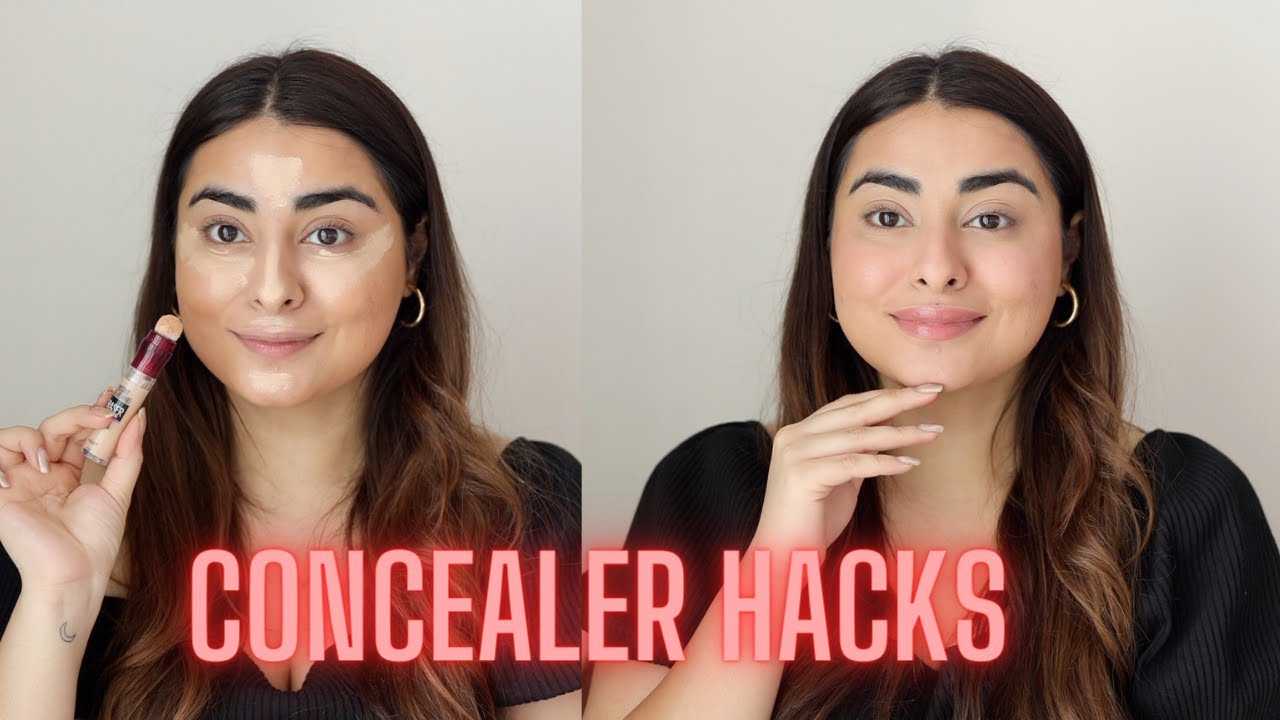
Twist the collar until the sponge is coated, then dab it under the eye and pat outward. That’s the whole routine for the Maybelline Instant Age Rewind Eraser, a liquid multi-use concealer in a click-up tube that conceals, color corrects, contours and highlights. Maybelline built it for dark circles, and it gives medium coverage through a built-in sponge applicator.
The name is the annoying part. Maybelline’s US site puts “Eraser” on a color correcting concealer in 4 shades (green, yellow, pink, orange), on a Baby Skin pore primer and on a Treatment Makeup foundation, and none of them do the same job (Maybelline US, 2026).
What Is the Maybelline Instant Age Rewind Eraser?
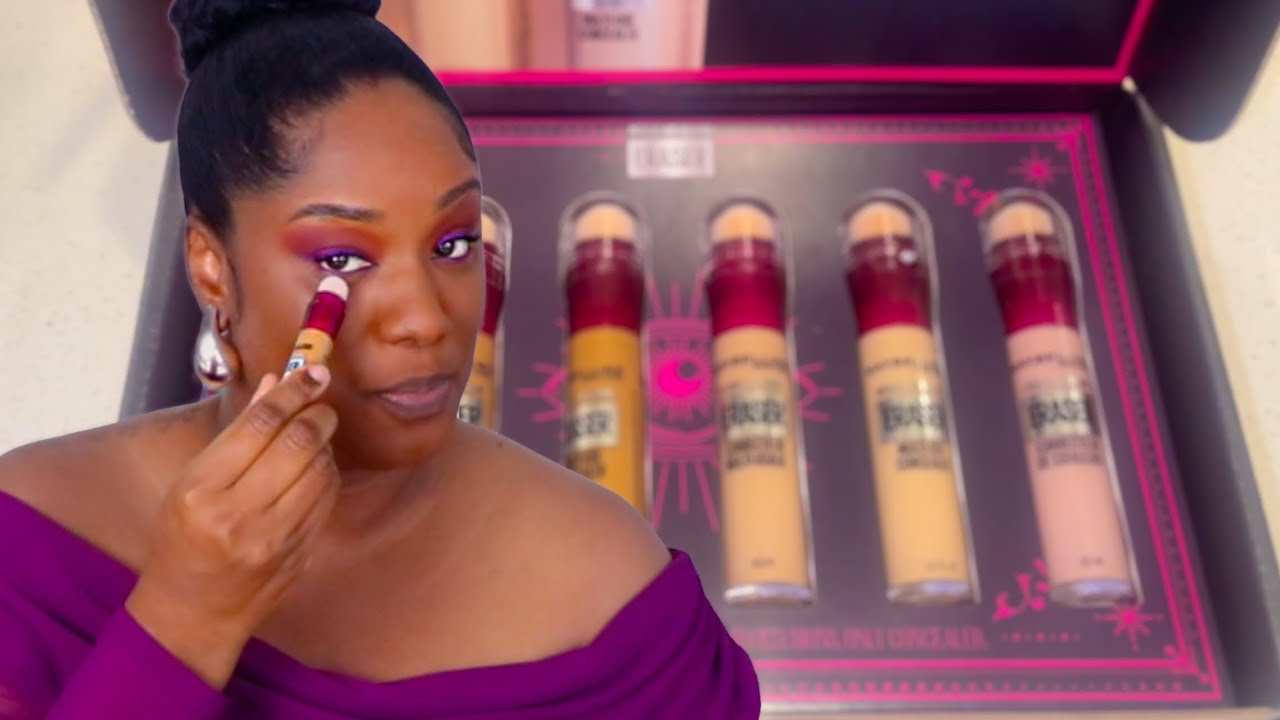
Most people who say “Maybelline eraser” mean the Instant Age Rewind Eraser Multi-Use Concealer. It’s a liquid in a click-up tube with a sponge tip built into the end.
The Eraser name also turns up on a Color Correcting Concealer, which comes in four tinted shades (green, yellow, pink, orange) in the same twist-up format. Baby Skin Instant Pore Eraser is a clear pore-blurring primer. Treatment Makeup is a foundation with the same twist mechanism, and you apply it across the whole face.
Those tinted sticks work as a color corrector, so they go under concealer and don’t replace it. The pore eraser belongs to a different step altogether. It’s a makeup primer, which goes on before foundation, and nothing in the application steps below applies to it.
On the formula, Maybelline’s US product page says silicone-based, medium coverage, vegan and non-comedogenic. It has no mineral oil, and no parabens or talc either. Haloxyl is the named active. The ingredient list also includes Lycium barbarum fruit extract, which is goji berry.
The tube holds 0.2 fl oz in the US, and retailers elsewhere list it as 6 ml. Maybelline claims up to 12 hours of wear and says it isn’t waterproof (Maybelline US, as of October 2026). The range runs to 18 concealer shades, with 4 more in the color correcting line.
How to Use the Maybelline Instant Age Rewind Eraser Step by Step

The basic routine is short.
- Pull the cap straight off the tube.
- Twist the collar in the direction of the arrows until concealer coats the sponge.
- Dab the sponge along the under-eye area.
- Pat the product outward with a ring finger or a damp makeup sponge.
- Add thin layers to any other area of redness or discoloration.
- Wipe the sponge with a dry tissue and recap.
Releasing the product
Maybelline doesn’t give a number of turns. The US label text only says first use can take a number of turns, and current Tesco and Sainsbury’s listings say some or several. Older UK copy on some Sainsbury’s listings is the exception, telling first-time users to turn the neck 8 times before product appears.
Turn in small bursts and stop when the sponge looks coated. Extra turns load more product than one eye needs.
A steady click means the mechanism is feeding. If the collar spins in silence and nothing comes out, that points to a fault in the tube.
Applying under the eye
Apply it straight from the sponge to the under-eye area, then go over any other redness or discoloration, which is the second pass in Maybelline’s US steps. Keep the first layer thin and build from there. Add more only after blending, and only where the shadow still shows.
The dab-and-blend logic is the same as for any liquid concealer, so general concealer technique carries over.
Blending

Maybelline’s own tutorial pats the product outward with a fingertip. That keeps the finish close to what the tube delivers, which Maybelline rates as medium coverage.
A damp makeup sponge sheers it out. One Well.ca reviewer described light to medium coverage when sheering it with a beauty blender. So fingers keep the coverage and a sponge softens it. For the sponge route, the basics of applying makeup with a sponge apply.
A brush works too, but put the product on the skin first. A makeup artist reviewing the tube on Beauty Bliss found it awkward to lift product off the sponge onto a brush.
Choosing the Right Shade by Undertone
Pick the shade that matches your skin tone and undertone, then test it on the jawline in daylight. Maybelline’s US page sorts the shades by undertone.
| Undertone | Shades (Maybelline US) |
|---|---|
| Cool | 95, 110, 121, 140, 149 |
| Neutral | 100, 120, 130, 144, 146, 147.5, 149 |
| Warm | 115, 141, 146.5, 148 |
Shade 149 sits in both the cool and neutral lists, which makes it the one to try if your undertone reads mixed.
The sources split on how light to go under the eyes. Maybelline’s US page says to choose the shade that matches your skin tone when concealing. The pro tips in the label text on iHerb’s listing go the other way and say a lighter shade brightens the under-eye area.
Match the shade if you’re covering discoloration. Go lighter only when brightness is the goal, and expect it to read paler against the cheek.
Swatch the two closest shades along the jawline and blend them in. If undertone is the sticking point, the guide to matching makeup to your skin tone walks through it. Maybelline’s Virtual Try-On tool also narrows the options before you buy.
Shade numbers are the identifier now. Buyers on Maybelline Canada’s product page ask which current shade replaces their old 120, and the Neutralizer and Brightener names now belong to the color corrector line.
When to Use the Neutralizer and Brightener
Maybelline’s US page now names the yellow Color Corrector as the Neutralizer and the pink one as the Brightener. The Neutralizer goes under your concealer when dark circles are extreme. The Brightener goes on the high points of the face for a lit-up finish.
Corrector goes on first, then concealer, with foundation over the top.
The yellow one cancels the blue and purple tones in dark circles, on any skin tone. The pink one belongs on the inner corners of the eyes, the brow bones and the bridge of the nose, per Maybelline’s US steps. The UK copy on Tesco listings and Maybelline Canada’s copy add the cheeks to that list.
On medium to deep skin tones, Maybelline recommends the orange corrector for dark under-eye circles and spots. Green handles redness on any tone.
Apply the corrector in a very thin layer and tap the edges until they disappear, then cover it with your matching concealer shade. Too much corrector turns cakey, and a walkthrough on how to apply color corrector covers the blending in more detail.
Skip the Neutralizer when the circles are mild. Maybelline reserves that step for extreme dark circles, and one concealer shade covers the rest.
Different correctors can share one face, according to Maybelline’s color corrector FAQ. Green goes on blemishes and yellow under the eyes, and pink gets dabbed in the corners.
Using It for Contour, Highlight and Full-Face Correction
Change the shade and the same tube does other work. A darker one contours and a lighter one highlights. One matched to the skin corrects, and one close to your foundation can stand in as a base. Maybelline’s own tutorials use it for all of these.
| Job | Shade rule | Where it goes |
|---|---|---|
| Contour | Slightly darker | Cheeks, jawline, nose |
| Highlight | Slightly lighter | Brow bone, cheekbones |
| Correct | Matches the surrounding skin | Blemishes, uneven patches |
| Whole-face base | Close to your foundation shade | Face, blended well |
Contour is where Maybelline’s own sources differ in wording. The tutorial says to use a shade darker than your skin, then smooth it out with fingers or a brush. The product FAQ says a shade slightly darker than the one you wear as concealer.
Start with the slight step. The usual cream contour technique applies here, so place the product, then diffuse the edges until the line disappears.
For highlighting, swipe the lighter shade onto the brow bone and cheekbones, per Maybelline’s tutorial. A guide to applying cream highlighter shows more placement options if you want to go beyond those two spots.
Maybelline says you can use the tube as a foundation if you like, as long as you blend well. Its FAQ pairs the concealer with silicone-based foundations such as Super Stay Lumi Matte, so check your base before layering.
Where the Maybelline Instant Age Rewind Eraser Falls Short

The formula gets fewer complaints than the packaging does.
Applicator stops dispensing
On Maybelline Canada’s product page, 3 of 7 reviews give one star, and 2 of those 3 blame the click mechanism. One tube released product that would not stop, and one stopped working after a week.
The sample is small, but older reader threads (Beautylish in 2013, Cap Hill Style comments) describe the same faults.
If it clicks but nothing comes out, keep turning in the direction of the arrows before calling it faulty, because the first fill is slow. A click that stops means the mechanism has stripped and the remaining product is stuck in the tube. Product that keeps flowing means the mechanism no longer holds, so the tube is unusable.
Return a tube with a stripped or runaway mechanism instead of prying it open. Maybelline Canada’s replies to those reviews send buyers to customer service, and one Beautylish commenter notes that most stores allow exchanges.
Product waste and brush use
The sponge holds product you never use. A makeup artist reviewing the tube on Beauty Bliss says a lot of product soaks into the sponge, and lifting it onto a brush is awkward.
Older forum threads call a sponge tip less sanitary, and Maybelline answers with an anti-microbial system and a dry-tissue wipe. Some reviewers pop the sponge off to get fuller coverage, but that isn’t a Maybelline step and it removes the cushion tip.
Blemishes and heavy coverage
One Well.ca reviewer rates it best under the eyes and not so good on blemishes. A Maybelline Canada reviewer disagrees, saying it covered hyperpigmentation spots and built up well.
Maybelline’s own comparison chart points full-coverage shoppers elsewhere. It lists Super Stay Longwear Liquid Concealer as full coverage with a matte finish and a 30-hour wear claim (Maybelline US, 2026).
Active breakouts need a different method from under-eye work, and a guide on covering acne with makeup goes through it.
Pick the eraser for under-eye work and light spot coverage. Pick something else when you need full coverage.
How Long Does It Last, and How Do You Keep the Applicator Clean?

Wear time depends on skin and setting more than on the tube. Treat the label’s wear claim as a ceiling.
One UK beauty blogger reports about 8 hours without creasing or fading when the concealer is set properly (Miss LJ Beauty, 2025). To stretch wear through harder conditions, Maybelline’s US FAQ recommends a makeup primer underneath and a setting spray on top.
Creasing is where the sources split. Maybelline calls the formula crease-resistant and a good choice for mature skin. A 2-star Well.ca reviewer says it sits in the creases of mature eyes, while others on the same page report no settling at all.
The product holds 4.1 out of 5 across 82 Well.ca ratings, so the split is real but not lopsided.
The divergence tracks technique. A desertcart reviewer says dry skin and a heavy layer make it settle, while a Well.ca reviewer who sets it with powder says it lasts all day. For a deeper fix, see how to prevent creasing under the eyes.
Care is simple. Never wet the sponge, which is Maybelline’s own rule. Keep the cap on between uses. Soap and water are out too, since the sponge feeds straight from the tube.
The anti-microbial system limits bacterial buildup, according to Maybelline, which is why the dry wipe is the whole cleaning routine.
Maybelline Instant Age Rewind Eraser FAQ
Should you set the Maybelline Instant Age Rewind Eraser with powder?
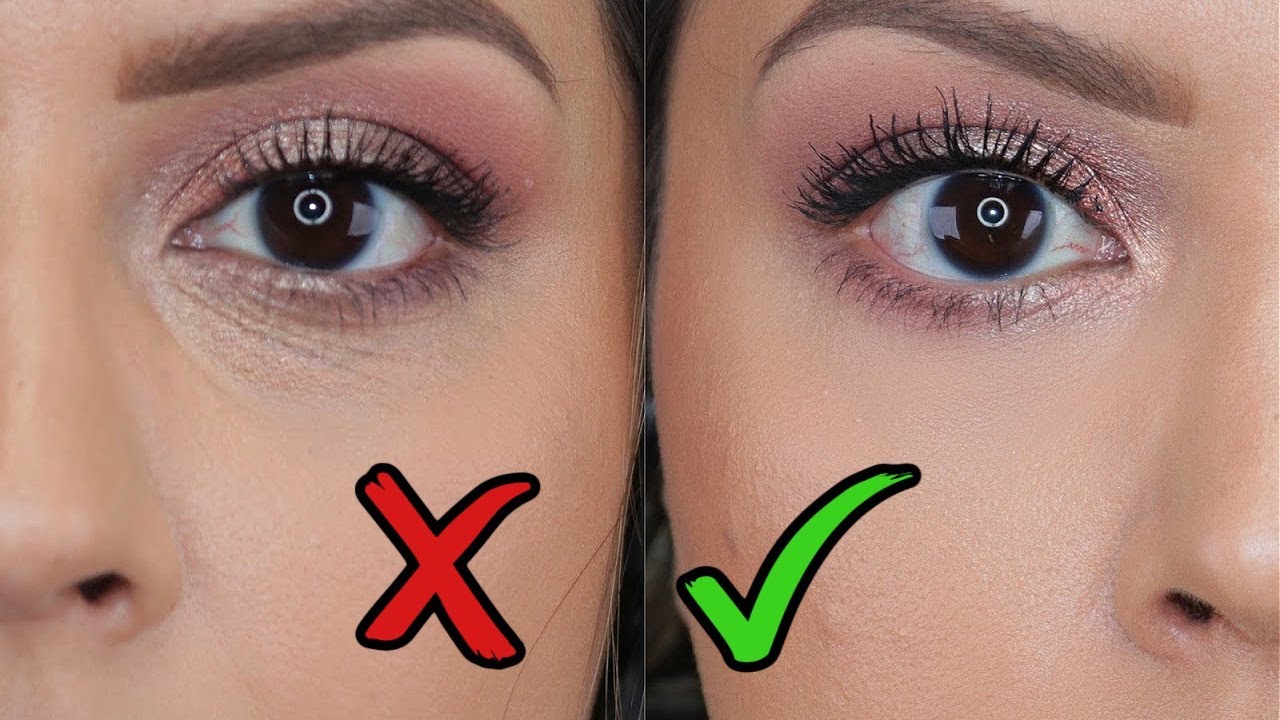
Yes, setting adds wear time. Maybelline’s color corrector page recommends setting concealer with powder or spray, and a desertcart reviewer taps on a small amount of translucent powder to stop it settling.
For technique, see how to apply setting powder.
How do you remove it at the end of the day?
Maybelline’s US steps say to use a makeup cleanser or micellar water. Work gently, because the product sits on thin under-eye skin. A guide on how to remove eye makeup covers the technique.
Can you mix two shades?
Yes. When a Maybelline Canada shopper could not find the discontinued Golden shade, the brand suggested mixing Sand and Honey to approximate it.
Dab both shades on the skin and blend them there, since the tube cannot pre-mix.
Is it suitable for sensitive or dry skin?
Both, according to Maybelline’s US FAQ, which lists all skin types, sensitive skin included. The hydrating formula makes it a particularly good fit for dry skin.
Is One Tube Enough for Under-Eye Coverage?
For most people, yes. The Maybelline Instant Age Rewind Eraser covers dark circles on its own, and a color corrector earns a place only after one layer leaves the shadow visible.
The order of operations matters more than the product count. Swatch the shade before anything else. Test the click mechanism in week one, and leave the corrector for last. A wrong shade or a faulty tube can’t be fixed by layering, so settle both before adding anything else.
A single tube is also a single point of failure. If the mechanism stalls, correction, contour and highlight all stop together.
That advice holds as of October 2026. A redesigned dispenser would change it, since the click-up mechanism remains the tube’s main complaint.
Once the eraser sits under foundation, a guide on how to layer makeup is the natural next step.

She started writing on the site after fielding the same questions from clients and friends often enough to just write the answers down: which red won't turn orange on a warm undertone, how to keep lipstick from feathering into fine lines, why a "12-hour" formula rarely survives dinner.
Every review on the site follows the same rule she uses with paying clients: wear it first, then decide if it's worth recommending.
- How to Make Eyeliner Last Longer Without Smudging - August 31, 2026
- How to Make Eyeshadow Last Longer All Day - August 29, 2026
- How to Find Your Undertone in 5 Easy Steps - August 27, 2026