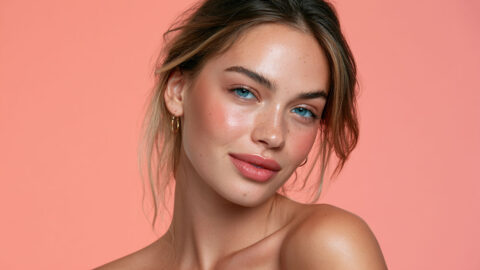
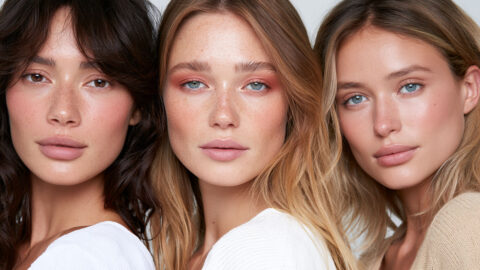
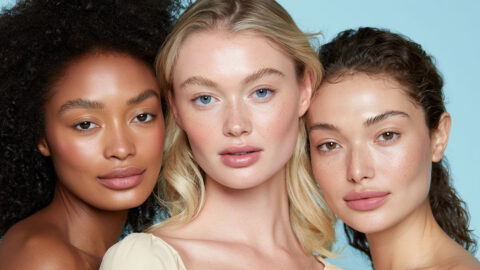
Coral, peach or soft pink is where I’d start, so reach for coral, peach or soft pink first. Orange sits opposite blue on the color wheel, which is the whole reason those shades work. A nude is fine when the lid is bold, and berry makes sense once the blue starts leaning violet.
Richard Russell published a study in Perception in 2009 and found that cosmetics consistently increase the luminance contrast between the eyes, lips and surrounding skin.
That matters most with navy. A deep navy lid and a dark lip each add to that contrast, so you end up counting it twice. Navy usually does better with a lighter lip.
Which lipstick colors go with blue eyeshadow?

Coral and peach are the safest picks, and soft pink does the job too. Nude keeps things quiet. Berry suits blue shades that lean violet.
It all comes back to the color wheel. Warm lip colors sit across from blue, while berry and plum sit right beside it.
Complementary lip colors: coral, peach and orange tones

Orange is the direct opposite of blue on the color wheel, and opposites give the strongest contrast. Adobe calls this complementary contrast. A second effect is worth knowing about too. Colors placed side by side shift how each other looks, an optical effect known as simultaneous contrast.
In practice, a coral or peach lip makes a blue lid look cleaner instead of competing with it.
Coral gives a bright, wearable contrast. Peach is softer and a little sun-warmed. If straight coral feels too loud, an orange-leaning pink does the job.
Pick the version that leans more orange than pink for the sharpest contrast. A guide to wearing coral lipstick covers how to keep it from turning loud on the lips.
Analogous lip colors: berry and plum

Purple-leaning berry, plum and raspberry sit next to blue on the wheel. They go with navy and cobalt, and with any blue that leans violet. The result is tonal and deep rather than contrasting, which suits an evening look.
The downside is weight. A saturated berry under a saturated navy lid gets heavy fast, especially on fair skin. A sheer berry stain fixes that.
Neutral lip colors: nude, soft pink and brown

When the eye carries all the color, a neutral lip lets it.
A light, sheer nude works well here, whether that’s pink-nude, peach-nude or a nude gloss, and it keeps a bright blue lid fresh and modern. On a navy or smoky blue eye, go deeper with a matte brown-nude or rosy brown. It grounds the look without adding a second focal point.
Maybelline’s blue eyeshadow guide recommends a nude lip gloss to balance the look, along with black mascara and a fresh pop of blush.
The nude has to match your coloring or it reads as a blank patch, so it helps to know how to choose a nude lipstick for your skin.
Best lipstick for each shade of blue eyeshadow
The deeper and more saturated the blue, the quieter the lip should be. Lighter blues can carry a bolder one.
| Eyeshadow shade | Best lip family | Finish | Skip |
|---|---|---|---|
| Navy | Pink, rosy nude, deep berry at night | Matte or satin | Brown-black lips |
| Cobalt or royal blue | Coral, peach or sheer nude | Satin or sheer | Fuchsia, blue-based red |
| Teal or turquoise | Coral, warm peach, muted orange | Matte or cream | Neon pink, full-strength orange |
| Baby or powder blue | Dusty pink, soft peach, light coral | Cream or gloss | Deep plum, black-cherry |
Navy reads as a softer alternative to black, so a pink lip looks deliberate next to it. 100% Pure’s navy look keeps the lip quiet with matte nude lipsticks or a completely bare mouth.
Cobalt and royal blue are loud, so the lip gets one of two jobs. It can contrast with coral or peach, or it can disappear into a sheer nude. Anything in between fights for attention. More ways to build a royal blue eye look show how far the lid can carry a face alone.
Teal and turquoise lean green, which pushes their true opposite from orange toward red-orange. A muted orange or a warm coral works, especially if you already know how to carry an orange lip.
King Power’s Power Mag advises keeping the rest of the face minimal with blue and turquoise lids, with no false lashes and no red lipstick.
A pale lid like baby or powder blue leaves room for color. Dusty pink, soft peach and light coral all work, and a glossy finish suits the pastel.
Is red lipstick a good match for blue eyeshadow?

Red works with blue eyeshadow only when one of the two is toned down. At full strength, both fight for the same attention.
Why the advice splits
Maybelline’s blue eyeshadow guide says to let the lid lead, with no red lips or harsh blush, so the look stays clear of 80s vibes. King Power’s Power Mag gives blue and turquoise lids the same treatment, a minimal face and no red lipstick.
Other people go the opposite way. Retro-styled looks pair blue lids with red lips on purpose, and the contrast is the point. A thin blue wash or a blue liner along the lashes also leaves enough room for a red lip to lead.
Neither camp is really arguing about color theory. The skip-red crowd wants a modern face, and the wear-red crowd is going for something graphic on purpose.
Which red undertone sits better next to blue
An orange-leaning red sits closer to blue’s complement, so it brightens the lid instead of flattening it. A blue-based red shares blue’s cool temperature (MAC Ruby Woo is the usual example). That looks sharper and more formal, though it competes harder with cobalt.
Neither is wrong. How each undertone reads on your own skin is a separate question, and a breakdown of cool versus warm reds helps there.
When red fails
Red goes wrong in one predictable setup. A full-lid cobalt eye meets a matte blue-red lip, and then strong blush gets added on top.
That’s a lot of saturated focal points fighting at once. Pull back one, usually the blush first, then the lid.
Tips for wearing red lipstick well help keep the lip controlled when the eye stays bold.
How do skin tone and undertone change the lipstick choice?

Undertone decides whether a coral or pink looks clean or muddy on you, and how much saturation you can carry depends on skin depth.
Match the lip’s temperature to your undertone first, then let the blue set the intensity.
Warm, cool and neutral undertones
Warm undertones do well with coral, peach, terracotta and a warm nude. Cool ones suit rosy pink, raspberry, berry and a cool nude. Neutral undertones get the most freedom, since most coral and pink families work and you can lean either way.
Cool undertones carry berry and blue-leaning pinks next to navy and baby blue without turning gray. A longer list of shades that suit cool undertones helps if berry is on the table.
Skin type charts do not settle undertone. The Fitzpatrick scale, introduced in 1975 with four types and described as six types (I through VI) in a 1988 paper in Archives of Dermatology, sorts skin by how it burns and tans.
Two people at the same type can sit on opposite sides of the warm and cool divide.
Fair and light skin
A saturated lip under a bold blue lid can wash fair skin out. Sheer pinks, soft corals and peach-nude keep the color in the face.
Stark brown-nudes tend to flatten pale skin, so leave them for deeper complexions.
Medium and tan skin
Warm coral or terracotta works for teal and turquoise. Navy likes a rosy nude, and a pale blue lid does better with warm peach.
Deep skin
Deep skin holds saturation well. Berry, brick and warm brown-nude keep their color next to navy and cobalt, so you can go bolder than fair-skin advice allows.
Shades chosen for deeper complexions are collected in this guide to lipstick shades for dark skin tones.
Matte, satin or gloss: which lip finish works with blue eyeshadow?

Give the lip the opposite finish of the lid. A shimmer or metallic blue takes a matte or satin lip, while a flat matte blue can handle gloss.
Only one surface should carry the shine, because two reflective areas split attention the same way two saturated colors do.
Matte is flat and steadies a glittery lid. Satin gives a soft sheen that works against either lid finish. Cream is comfortable color with little shine, and sheer is the lightest weight, which lets the lid lead. Gloss adds light to the lip, so it balances a matte blue and fights a shimmery one.
Andrew James, Lancome’s national makeup artist, told Glamour South Africa (2017) that matte makes features look smaller and darker while shimmer brightens them. His advice is to mix the two across the face.
L’Oreal Paris gives related advice for shimmer eyeshadow: balance a shimmery lid with a matte crease, and keep the lip neutral.
Satin is the safe middle when you cannot decide, and this breakdown of how matte and satin lipsticks differ helps you pick.
To keep a nude or pink color but add shine under a matte blue, layer gloss over your lipstick instead of switching products.
How bold should the lip be for each type of blue eyeshadow look?

Set the lip one step quieter than the lid. A strong blue gets a sheer or neutral lip, and a soft blue wash can carry a stronger one.
| Look | Blue eyeshadow | Lip |
|---|---|---|
| Everyday | Thin wash on the lid | Sheer pink or coral |
| Office | Navy liner or a soft blue lid | Satin rosy nude |
| Evening | Full navy or cobalt | Nude, or one bold shade |
| Editorial | Saturated, graphic blue | Quiet nude or a tonal match |
For evening, the rest of the face has to stay quiet too, and a rundown on doing makeup for a night out covers it.
The bold eye, quiet lip rule and where it bends
NARS founder Francois Nars put the rule in one line for W Magazine: “When the eye makes a statement, the lips should be quiet.”
Not every source agrees. A Beauty Panel on FASHION Magazine argues that statement eyes and lips can share a face when the undertones of lipstick and eyeshadow are in sync and the base stays clean.
Lancome Beauty Advisor Olivia Thompson (makeup.com) suggests keeping a statement look monochromatic for balance, such as a dark lip with nude-toned smoky eyes.
In practice the rule holds for a saturated lid with a contrasting lip. It bends when both sit in the same cool family.
Brunet’s balance guide maps four placements: dark eyes with a dark mouth, light eyes with a dark mouth, dark eyes with a light mouth, and light eyes with a light mouth. A pale powder-blue lid sits in the light-eye group and can take a deeper lip, while navy belongs in the dark-eye group.
How to balance the lip against the eye
- Choose the focal point, eye or lip, and keep the other one lower in saturation.
- Drop the lip one step below the lid’s intensity.
- Pick a lip liner that matches the lipstick or sits in the same color family, then blend the two so no hard line shows (Maybelline’s lip liner guide).
- Fill the whole lip with liner before the lipstick, which helps stop feathering (Revlon).
- Choose a blush from the same family as the lip, only softer.
Line placement is where most people slip, and a walkthrough on applying lip liner covers the technique.
Which lipstick shades clash with blue eyeshadow?
Cool, saturated lips clash with cobalt. Full-strength orange fights teal, near-black lips look heavy under navy, and metallic lips compete with metallic lids.
What they share is competition. When lid and lip carry the same saturation or the same shine, neither one leads.
Fuchsia or a blue-based red against cobalt goes wrong because both are cool and high in chroma, so they fight instead of contrasting. Swap in a coral, or thin the lid to a liner.
Full-strength orange with teal is complementary on paper, but two loud colors read as costume. Mute one of them, usually the lip, with a sheer wash.
Near-black lips with a navy smoky eye make two dark masses, which looks heavy, especially on lighter skin. A warm berry or sheer brown works better. Dark lips stay wearable when the rest of the face stays light, as a guide to wearing dark lipstick explains.
Lips finished in metallic lipstick reflect light the way a foiled blue lid does, so the shine splits attention. Switch the lip to matte.
Dial one of the two down and every pairing above becomes workable.
Lipstick for Blue Eyeshadow FAQ
Does natural eye color change the lip color I pair with blue eyeshadow?
Only slightly. The shade of blue on the lid and your skin undertone decide the lipstick, while eye color mainly changes which blue flatters you.
Brown, green, hazel and blue eyes all take the same coral, pink or nude pairings.
Can you wear blue lipstick with blue eyeshadow?
Yes, but only when the lid steps back. Maybelline’s guide to dark blue lipstick pairs it with bronze or light nude eyeshadow, which leaves the lip as the one blue focal point.
A matching blue lid and lip works only as a deliberate monochrome look.
What blush goes with blue eyeshadow and lipstick?
Pick a soft blush from the same family as the lip, such as peach with coral or rosy pink with pink.
Keep it sheer. Maybelline’s blue eyeshadow guide warns against harsh blush so the lid stays the star.
Which lip color works if blue is only on the liner or lower lash line?
Almost any shade works, because a thin blue line leaves the lip free to lead.
Red, coral, berry and bright pink all sit well here, including the combinations that would clash against a full lid of cobalt.
How to Test a Lipstick Before Committing to Blue Eyeshadow
Test lipstick for blue eyeshadow against the finished lid, never on its own. A shade that looks right in the tube changes tone once the blue sits beside it.
The order that costs the least rework starts with finishing the lid. Then apply the lip color as a sheer layer, and save the liner and a fuller pass for last.
The lid comes first because it fixes the one variable the lip has to answer to. Reversing the order means redoing the lip every time the blue changes.
The catch is time. A sheer first layer protects the eye look but shows less of the lipstick’s undertone, so a second pass is needed before the final call.
For ideas on building out the rest of the eye, browse complete blue makeup looks.

She started writing on the site after fielding the same questions from clients and friends often enough to just write the answers down: which red won't turn orange on a warm undertone, how to keep lipstick from feathering into fine lines, why a "12-hour" formula rarely survives dinner.
Every review on the site follows the same rule she uses with paying clients: wear it first, then decide if it's worth recommending.
- How to Make Eyeliner Last Longer Without Smudging - August 31, 2026
- How to Make Eyeshadow Last Longer All Day - August 29, 2026
- How to Find Your Undertone in 5 Easy Steps - August 27, 2026