Apply Rare Beauty blush the same way across every format and something will go sideways. The brand doesn’t use one method, and which one you need depends on what’s in your hand.
Soft Pinch Liquid Blush takes 1 to 2 dots per cheek, patted in with fingertips or the Soft Pinch Blush Brush. Stay Vulnerable Melting Blush gets dabbed on. Soft Pinch Matte Bouncy Blush goes directly onto the skin, and the Soft Pinch Luminous Powder Blush is swept on with the brush.
Rare Beauty’s liquid directions stop at two dots, and its 2026 product page states that a single dot delivers high-impact color.
With that much pigment, how much you use and how fast you blend matter more than anything else.
Which Rare Beauty blush format should you use?

The table below lines the formats up. The liquid is patted in, the Melting Blush is dabbed on with a dense brush or fingertips (or stippled on with the Soft Pinch Blush Brush), and the Matte Bouncy goes on with fingertips or that same brush. The powder gets swept on and then tapped onto the apples of the cheeks.
| Format | Finish and wear | Amount and tool | Best for |
|---|---|---|---|
| Soft Pinch Liquid Blush | Dewy or matte, up to 12 hours (brand claim) | 1-2 dots per cheek, fingertips or brush | Strong color from little product |
| Stay Vulnerable Melting Blush | Satin cream, water-resistant | Dense brush or fingertips dabbed onto the apples, or the Soft Pinch brush tapped into the compact and stippled on; layered for more | A buildable, forgiving flush |
| Soft Pinch Matte Bouncy Blush | Blurred matte, water-, sweat- and humidity-resistant | Fingertips or brush on moisturized skin | Matte cream-to-powder color |
| Soft Pinch Luminous Powder Blush | Radiant with pearls, transfer-proof | Brush swept across the pan, tapped on | Powder color with glow |
Rare Beauty lists 16 liquid shades, 10 Matte Bouncy shades, 6 Luminous Powder shades and 5 Melting Blush shades on its product pages (rarebeauty.com, as of October 2026).
Twelve of the 16 liquid shades are dewy and 4 are matte (Bliss, Love, Grace and Faith). Matte Bouncy is matte in every shade. The Luminous Powder gives you pearl radiance from a powder, and the Melting Blush is the lowest-risk first pick.
The liquid is the bestseller, but the cream is the safer first buy. Rare Beauty’s own FAQ presents the Melting Blush as the flush that is hard to overdo and the liquid as the high-payoff formula where a little goes a long way. If it’s your first Rare Beauty blush, I’d start with the cream.
Rare Beauty built the Luminous Powder Blush as a hybrid of its Soft Pinch Liquid Blush and Positive Light Silky Touch Highlighter, which is why the finish carries pearls.
Anyone new to cheek color in general can compare the main types of blush before settling on a format.
How to apply Soft Pinch Liquid Blush step by step

The sequence is short.
- Wipe excess product from the doe-foot applicator back into the tube.
- Place one dot on each cheek, or two for a bolder result.
- Pat the dots in with fingertips or the Soft Pinch Blush Brush. Pat, do not drag.
- Blend right away, before the product sets.
- Step back and add a small amount of color only where the flush looks thin.
The same pat-and-blend sequence applies to other liquid cheek products, and a general guide to applying liquid blush covers the variations.
How many dots per cheek
One dot gives a soft flush, though Rare Beauty says a single dot delivers high-impact color, so don’t expect it to look faint. Two dots is the top of the brand’s directions and gives a bolder pop.
A Romper reviewer puts three on the cheekbones. The same reviewer tells newcomers to start with one or two.
The brand’s directions stop at two. Anything beyond that turns into a second blending job.
Using the back of your hand for control
Rare Beauty’s directions offer a second route. Apply the blush to the back of your hand first, pick it up with the Soft Pinch Blush Brush, then blend onto the cheeks.
That way you settle on the amount before anything touches your face.
One Ulta reviewer reports that the liquid blends well only when worked in right after placement, so have the brush or fingertips ready before the first dot goes on.
Getting a dewy finish with Positive Light Liquid Luminizer
Rare Beauty directs mixing Soft Pinch Liquid Blush with Positive Light Liquid Luminizer before applying it to the cheeks, for a lit-from-within glow.
The directions give no mixing ratio. Mix on the back of your hand and add blush dot by dot until the color reads right.
Since 12 of the 16 liquid shades are already dewy, the mix is mainly a way to turn one of the four matte shades dewy.
Fingers, sponge or brush: the best tools for blending Rare Beauty blush

The Soft Pinch Blush Brush gives a diffused finish, and fingertips are the brand’s default pat-in method. A damp makeup sponge only makes sense for a sheer wash. Rare Beauty’s directions name just the first two.
Fingertips
Fingertips are Rare Beauty’s own method for the liquid, the Matte Bouncy Blush and the Melting Blush. They cost nothing extra, and adding color one dot at a time is easy. The downside is less diffusion at the edges than a brush gives you.
Soft Pinch Blush Brush
The Soft Pinch Blush Brush is angled, with multi-length synthetic fibers, and it’s sold separately at $26 on rarebeauty.com (as of October 2026).
Rare Beauty uses it to buff the liquid, stipple the Melting Blush, apply the Matte Bouncy Blush and sweep the Luminous Powder Blush. The brush’s own product page describes it as a liquid and cream brush, yet the brand’s powder directions call for it too.
It gives a soft, diffused finish and covers all four formats with one brush. It also works with the back-of-hand method. It does cost extra.
Damp makeup sponge
A sponge is not part of Rare Beauty’s directions. It presses color into the skin instead of buffing it, and the basics of applying makeup with a sponge carry over to blush.
You get a sheer, soft-edged result, and a Beautyblender-style sponge is probably already in your makeup bag. The catch is that the sponge absorbs some product, so each application uses more blush for less color.
Fluffy and stippling brushes
Makeup artist Bobbi Brown recommends a medium, round, fluffy brush for powder blush (MasterClass). Lisa Potter-Dixon, head makeup artist for Benefit Cosmetics, suggests a fantail brush for anyone who picks up too much powder with a large fluffy one (SheerLuxe).
These suit powder formats and leave soft edges, but they tend to over-pick product. The angled Soft Pinch brush is shaped for liquid and cream, so it’s a different tool for a different job.
Where to place Rare Beauty blush on your face shape
The default placement is the apples of the cheeks, blended up and out toward the temples. Makeup artists shift the starting point by face shape, and they do not all agree on where it should be.
Default placement by format
Rare Beauty has you tap the Luminous Powder onto the apples of the cheeks and dab the Melting Blush there too. For the liquid and the Matte Bouncy, the directions name no location, only “each cheek” and “directly onto your skin”.
Rare Beauty names a specific spot only for the powder and the Melting Blush, so face shape guidance for the other two has to come from makeup artists.
Adjusting placement for face shape
| Face shape | Common ground | Where sources split |
|---|---|---|
| Round | Upward sweep toward the temples, matte per Brown | Below the apples (Brown, Potter-Dixon) or slightly above (Glazer, Tilbury) |
| Oval | Blended up and out toward the temples | Cheekbone tops (Brown), cheek center (Potter-Dixon), apples (Tilbury) |
| Square | Blended outward to soften angles | High on the apples (Patrick Ta) or aimed high (Glazer), versus the apples (Tilbury) or a little below the cheekbones (Brown) |
| Heart | A C shape rising to the temples | Starting below the apple (Brown) or under the cheekbones (Potter-Dixon), on the apples (Tilbury), or higher overall (Glazer) |
A separate guide goes deeper on applying blush on different face shapes.
Where the artists disagree
Round and oval faces split the artists most.
All of them sweep color upward toward the temples. They differ on where to start. Bobbi Brown begins round-face color just below the apples, while Ashlee Glazer warns that blush too close to the apples looks too cherubic and starts above them.
Because Soft Pinch dots are small and pigment-dense, the dot marks the center of intensity and the blend sets the shape. Place the dot where you want the deepest color, then blend toward the temple.
Brown’s matte advice for round faces maps to the four matte liquid shades and the Matte Bouncy Blush (rarebeauty.com, as of October 2026).
Applying the cream and powder blushes
None of these work in dots. Color builds in layers, and each formula has its own habits.
Stay Vulnerable Melting Blush
Rare Beauty’s own product page names the apples of the cheeks and says a dense brush or fingertips both work. The Soft Pinch Blush Brush page describes tapping or swirling the brush into the compact and stippling over the cheeks instead.
That makes the Melting Blush the second format with a named placement, and it confirms that fingertips are approved.
Press the color onto the apples rather than swiping across them, then keep dabbing outward until the edge disappears. For more color, repeat, as Rare Beauty directs.
The dab-and-blend method carries over to any cream formula, and a separate guide covers applying cream blush in more detail.
Soft Pinch Matte Bouncy Blush
Prep decides how this one goes on.
Rare Beauty states that best results come on skin prepped and hydrated with moisturizer. A guide on how to prep skin before makeup walks through the full routine.
Use fingertips or the Soft Pinch Blush Brush, applied directly to the skin. Build it up for bright and bold, or blend it soft.
Soft Pinch Luminous Powder Blush
- Sweep the Soft Pinch Blush Brush gently across the powder.
- Tap lightly onto the apples of the cheeks.
- Add more to build color and radiance, or diffuse with sweeping circular motions for a softer look.
Color and radiance build together, so each extra layer adds sheen as well as pigment.
For a more intense flush, Rare Beauty’s tip is to layer the powder over Soft Pinch Liquid Blush.
Should Rare Beauty blush go on before or after foundation?
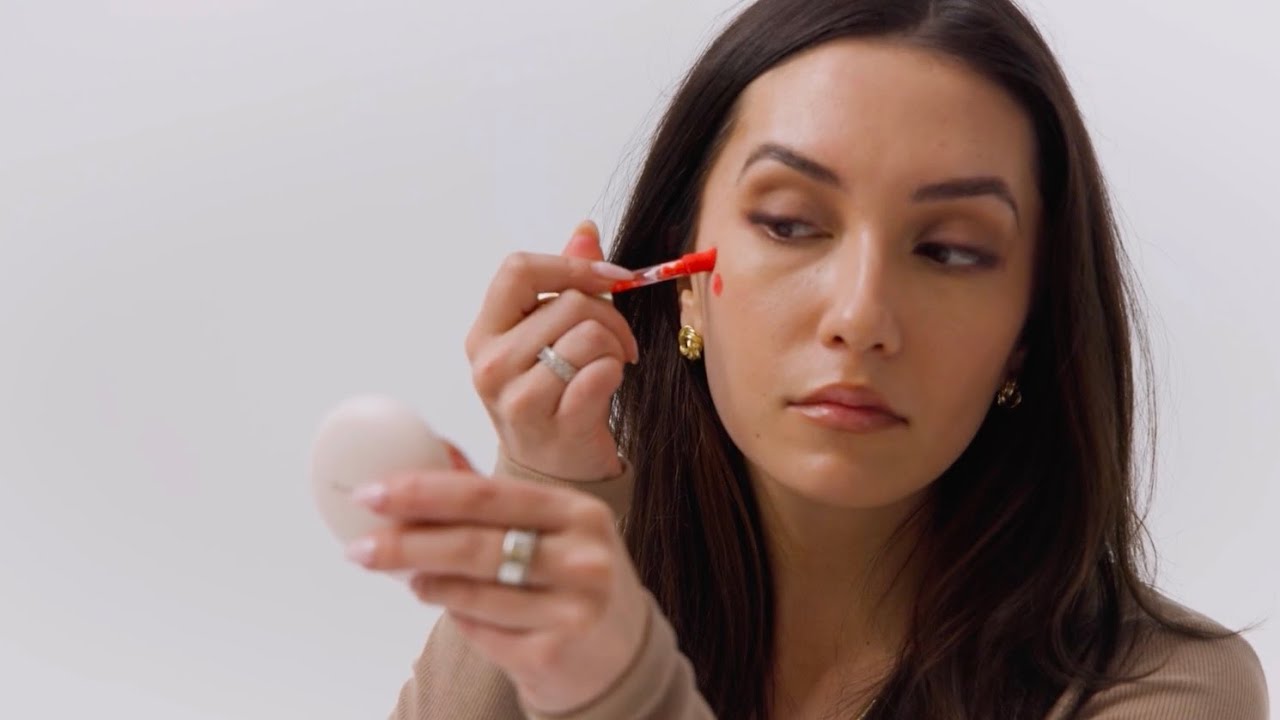
Either works. Rare Beauty states that Soft Pinch Liquid Blush layers over liquid and powder formulas without disturbing them and goes on bare skin too, and its tip for a more natural look is to apply it under foundation. That gives an ultra-natural flush.
The FAQs for the liquid and the Melting Blush confirm both work over liquid foundation and on bare skin. Powder foundation is approved for both as well, with a catch.
Artists lean the other way on powder bases. Go-To Skincare’s blush guide warns that cream can grab onto powder, causing piling or dragging and a patchy look.
Rare Beauty’s Melting Blush FAQ says the formula layers over powder, so the two sources disagree. Pat gently on a powder base and keep the first layer thin until you see how that foundation reacts.
Layering with highlighter, bronzer and other blushes

Liquid and cream go on first and powder goes second, which is the order Rare Beauty’s own Luminous Powder tip follows. The brand also directs pairing the liquid with contour, bronzer, powder blush and highlighter.
Soft Pinch Matte Bouncy Blush layers well over makeup according to 100% of 55 people in a Rare Beauty consumer perception study.
Where blush sits among the rest of the face, a guide to layering makeup lays out the full order.
Making the color last
Rare Beauty recommends setting the Melting Blush with Always an Optimist 4-in-1 Mist. Makeup artist Tamryn Jefferies says blush over foundation has something to cling to (Clicks, 2019), and Makeup.com’s guide to splotchy blush (2022) says to set after blending, not before.
A general guide on how to apply setting spray covers the technique behind the mist.
Choosing a Rare Beauty blush shade for your skin tone

Start with undertone, then think about depth. Pinks, mauves and berries suit cool undertones. Warm ones do better with peach, coral and terracotta, and neutral undertones sit well with neutral pinks and rosy browns.
Rare Beauty publishes a color descriptor for each shade, not an undertone label (rarebeauty.com, as of October 2026), so the table below pairs those descriptors with artist guidance. A broader guide on how to match makeup to your skin tone covers the groundwork.
| Undertone | Shade families | Rare Beauty shades |
|---|---|---|
| Cool | Pinks, mauves, berries (Maybelline, Charlotte Tilbury) | Happy (cool pink), Believe (true mauve), Faith (deep berry) |
| Warm | Peach, coral, terracotta (Maybelline, Faces Canada) | Joy (muted peach), Love (terracotta), Resilience (warm chestnut) |
| Neutral | Neutral pinks, rosy browns (Charlotte Tilbury) | Encourage (soft neutral pink), Hope (nude mauve), Bliss (nude pink) |
Matching skin depth
Charlotte Tilbury recommends pale pinks and peaches for fair-to-medium skin and more pigmented reds and brighter pinks for tan-to-deep skin.
On the lighter side of the range you’ll find Joy (muted peach), Bliss (nude pink) and Nearly Neutral (soft neutral pink). The more pigmented end includes Grateful (true red), Lucky (hot pink) and Adore (bright pink).
Buxom Cosmetics warns that on deep skin, blue-based pinks and berries can lean ashy on warm-toned complexions. A bright shade on fair skin calls for a single dot.
Olive skin: where sources disagree
Sources classify olive skin three different ways. Maybelline Australia calls it a warm, green undertone. Buxom says green undertones lean cool, and Charlotte Tilbury places olive in the neutral group, a mix of warm and cool.
Two of the three still point to shades that warm the cheeks: Buxom to warm them up, Maybelline to bring out natural bronze hues. Tilbury recommends neutral pinks and rosy browns instead, so compare a warm-side shade like Love (terracotta) against Hope (nude mauve).
What goes wrong with Rare Beauty blush and how to fix it
Usually it’s too much pigment or uneven blending, and sometimes the format or shade just doesn’t suit your skin. Either way, the fix doesn’t involve wiping your face clean.
Too much color
- Skip the makeup wipe. Makeup artist Kasey Spickard says the blush can be fixed in place (Makeup.com, 2021).
- Swipe and twist a damp beauty sponge or stippling brush over the area to lift pigment.
- Tap a small amount of foundation over the spot with a brush or sponge.
Tamryn Jefferies offers a drier route. Sweep a clean powder or blush brush across the cheeks to shift the pigment.
Patchy edges and streaks
Go-To Skincare traces streaky blush to blending that stops too early, so keep working outward until the edge disappears. A rough base matters too, since flakes and dead skin cells interfere with application, per Makeup.com (2022).
A dirty brush is the other usual culprit. Product and oil buildup on the bristles keeps blush from going on smoothly.
The same patch-and-blend logic applies across the face, and a guide on how to fix patchy makeup covers the rest.
A shade that reads too purple
An Ulta reviewer reports that one liquid shade came out too purple on their skin.
Check the descriptor against the undertone table before ordering. Rare Beauty’s Shade Match Live Chat, listed under customer service on rarebeauty.com (as of October 2026), is another option. A shade that reads purple on warm skin points toward the warm-side shades in the table.
Textured skin and cream formulas
Makeup artist Lisa Aharon recommends powder over cream blush for rosacea, acne or textured skin because cream draws attention to texture (Beautycrew, citing Who What Wear).
Rare Beauty’s study disagrees for one product: 100% of the same 55 people said Soft Pinch Matte Bouncy Blush does not settle into creases or emphasize skin texture.
The artist addresses cream blush in general, and the brand addresses one cream-to-powder formula. Try the Matte Bouncy Blush first, since it is the only Rare Beauty blush whose product page claims it won’t emphasize skin texture.
Rare Beauty Blush FAQ
Is Rare Beauty blush vegan and cruelty-free?
Yes. Rare Beauty labels Soft Pinch Liquid Blush, Soft Pinch Matte Bouncy Blush, Soft Pinch Luminous Powder Blush and Stay Vulnerable Melting Blush as vegan and cruelty-free.
All four also carry a paraben-free label (rarebeauty.com, as of October 2026).
Does Rare Beauty blush work on sensitive skin?
Rare Beauty labels 3 of its 4 blush formats suitable for sensitive skin: the liquid, the Matte Bouncy Blush and the Luminous Powder Blush.
The Melting Blush page lists dermatologist tested and noncomedogenic instead (rarebeauty.com, as of October 2026).
How long does a tube of Soft Pinch Liquid Blush last?
Rare Beauty’s product page gives no usage estimate. The dose is what stretches a tube, since the directions call for 1 to 2 dots per cheek.
A Live That Glow reviewer found two dots per cheek made the tube last and last.
Can I match my blush to my eye and lip color?
Yes, with the Stay Vulnerable line. Rare Beauty sells Stay Vulnerable Liquid Eyeshadow and Stay Vulnerable Glossy Lip Balm in the same 5 shades as the Melting Blush.
Those shades are Nearly Neutral, Nearly Rose, Nearly Berry, Nearly Mauve and Nearly Apricot.
How do I clean the Soft Pinch Blush Brush?
Wash it with mild soap and water, the same way as any synthetic makeup brush. Makeup.com (2022) ties dirty bristles to blush that goes on unevenly.
A guide on how to wash makeup brushes covers the full method.
Building a Daily Rare Beauty Blush Routine
For daily wear, pick one format and one tool, use one dot per cheek, and blend on the spot. Evening adds a layer, not more dots.
Shade comes first, matched by descriptor and undertone. Tool is next, fingertips or the Soft Pinch Blush Brush. Dose comes last: one dot, then a second only if needed.
No technique fixes a mismatched shade, and the tool sets how much product lands. Dose is the only variable that still adjusts afterward.
For evening, the brand’s powder-over-liquid tip and the artists’ cream-before-powder order agree: two dots of liquid at most, then Soft Pinch Luminous Powder Blush swept over them.
As of October 2026, rarebeauty.com tags 3 liquid shades (Adore, Spirited, Resilience) and 3 Matte Bouncy shades (Divine, Spirited, Soulful) as new, so recheck descriptors before reordering. A guide to applying Rare Beauty highlighter covers the next step for the cheek.

She started writing on the site after fielding the same questions from clients and friends often enough to just write the answers down: which red won't turn orange on a warm undertone, how to keep lipstick from feathering into fine lines, why a "12-hour" formula rarely survives dinner.
Every review on the site follows the same rule she uses with paying clients: wear it first, then decide if it's worth recommending.
- How to Make Eyeliner Last Longer Without Smudging - August 31, 2026
- How to Make Eyeshadow Last Longer All Day - August 29, 2026
- How to Find Your Undertone in 5 Easy Steps - August 27, 2026