Clean skin first, then 1 to 2 pumps of the retinoid serum, then moisturizer, then eye cream. That’s the order for Clinique Smart Clinical Repair, and in the morning the moisturizer should carry SPF.
The serum stays off the eye area. The eye cream covers that part.
The label and general dermatology advice split on timing. Clinique labels the serum for use both morning and night, while Sand Lake Dermatology’s patient guidance places topical retinoids at bedtime.
Daily sunscreen is required with the serum, and other retinol products stay out of the routine.
Which Clinique Smart Clinical Repair products do you need?

Start with the serum. One moisturizer goes on top of it, and mornings need an SPF step. That’s a complete routine.
Everything else in Clinique Smart Clinical Repair is optional, and how much of it you add depends on how much you want to target.
| Product | Role | Where it goes | When |
|---|---|---|---|
| Wrinkle Correcting Serum | Core treatment, first step | Face, not the eye area | Morning and night |
| Wrinkle Correcting Cream or Lifting Face + Neck Cream | Moisturizer after serum | Face and neck | Morning and night |
| SPF 30 Wrinkle Correcting Cream | Daytime moisturizer with sunscreen | Face | Morning only |
| Wrinkle Correcting Eye Cream | Eye-area step | Around the eye area | Morning and night |
| Overnight Recovery Cream + Mask | Night cream or leave-on mask | Face and neck | Nightly |
The AM/PM Retinoid Balm is a 3 g stick meant for individual lines. Clinique US says it suits crow’s feet, frown lines, smile lines and vertical lip lines, but not the eyelids.
A fuller routine adds the eye cream and swaps in the overnight cream at night. Skip those and you still have everything the label asks for.
Clinique describes the serum as dermatologist developed, allergy tested, fragrance free and safe for sensitive skin, for all skin tones and types.
Those are brand claims. Some reviews posted on Clinique UK report redness and a burning sensation.
How to apply the Clinique Smart Clinical Repair serum

It goes on twice a day, over clean skin, with the eye area left alone.
- Cleanse your face. The serum goes on clean skin.
- Dispense 1 to 2 pumps onto your fingertips.
- Spread it all over the face and skip the eye area.
- Follow with your moisturizer. Clinique’s directions give no wait time between the two.
- Repeat at night.
Clinique gives a range, not a fixed dose, so the amount depends on how much skin you are covering.
The eye area gets its own product. The Wrinkle Correcting Eye Cream is massaged in gently around the eyes, separately from the serum.
Twice-daily use rests on the formula. Clinique’s product copy lists 1% advanced retinoid and calls it gentle enough for morning and night.
Does the serum go before or after moisturizer?
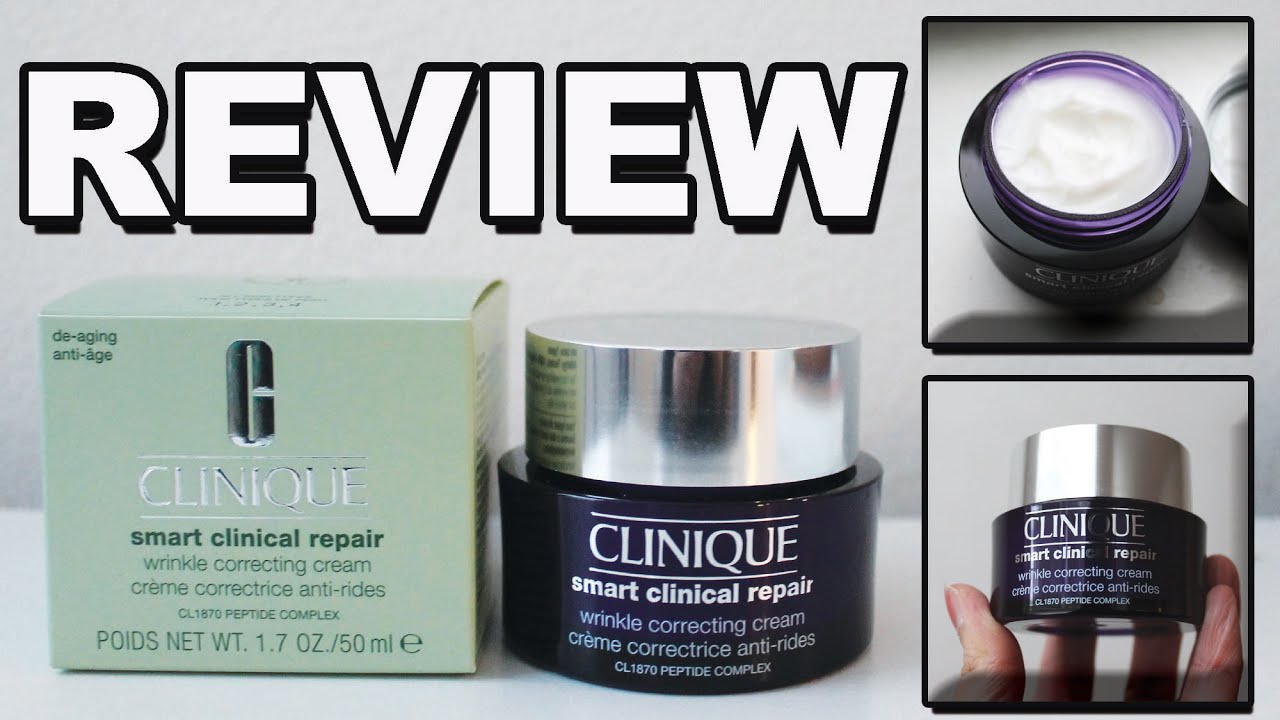
Serum goes first, straight after cleansing, and moisturizer follows. Every source retrieved agrees on that much.
The disagreement is about what comes after the serum. As of October 2026, the product pages for the line place the SPF moisturizer and the eye cream in different positions.
| Source | Morning | Evening |
|---|---|---|
| Clinique.com serum page | Serum, moisturizer, eye cream, SPF moisturizer | Same, without the SPF step |
| Ulta listing, SPF 30 cream | Serum, SPF 30 cream, eye cream | Not stated |
| Sephora UK, eye cream page | Serum, SPF 15 moisturizer, eye cream | Serum, eye cream |
| Easypara, SPF 30 cream | Serum, SPF 30 cream (eye cream morning and night) | Repair or lifting cream, eye cream |
| Clinique Hong Kong, overnight cream | Not stated | Serum, overnight cream, eye cream |
Neither order is wrong on the label. The pages just never reconcile them.
I’d go with serum, SPF moisturizer, eye cream in the morning, since both the SPF 30 cream directions and Sephora UK land on that sequence.
The Retinoid Balm has a clearer slot. Clinique US advises applying it after the serum.
Morning and evening routines with Clinique Smart Clinical Repair

The serum belongs in both routines. SPF is the only step that stays in the morning.
Skinsort’s community data (June 2024) shows how far real routines drift from that instruction. Of the 82 routines that include the serum, 87% use it daily, yet only 22% apply it in both the morning and the evening.
Clinique’s directions say twice a day. Most of those routines settle for a single slot.
Morning routine
Spread 1 to 2 pumps of serum over clean skin, eye area excluded. Next comes an SPF moisturizer, either Clinique Smart SPF 15 Custom-Repair Moisturizer or the SPF 30 Wrinkle Correcting Cream. The eye cream goes last, massaged in gently around the eye area.
The SPF 30 cream carries no retinol, according to a Clinique US customer answer, so it sits alongside the serum without touching the label warning.
If your moisturizer has no SPF, sunscreen goes on after it. Daily sunscreen is a stated requirement with the serum.
Evening routine
No SPF at night.
After the serum, pick a single moisturizer. The Wrinkle Correcting Cream and the Lifting Face + Neck Cream both work. So does the Overnight Recovery Cream + Mask, which can be used nightly or as a thicker leave-on mask when skin needs it.
Clinique’s Hong Kong directions apply the overnight cream after cleansing, exfoliating and serum, then finish with the eye cream.
The eye cream closes the evening routine too, per Sephora UK and Easypara.
What do the active ingredients in the serum do?

The retinoid is hydroxypinacolone retinoate, which Clinique says accelerates cell turnover and smooths the skin. That’s the resurfacing part.
Repair comes from the CL1870 Laser Focus Complex, a peptide blend built around palmitoyl tripeptide-1, acetyl hexapeptide-8 and palmitoyl tetrapeptide-7. It’s aimed at collagen and the skin’s support structure, and the peptide load is 9.5% according to Clinique’s product copy.
Hyaluronic acid handles the plumping of fine, dry lines. A caffeine and algae extract blend sits in the formula to help minimize irritation.
The ingredient list also carries ascorbyl glucoside, a vitamin C derivative, and tocopheryl acetate (vitamin E), per the retailer listing for the serum set.
Skinsort’s ingredient data confirms the retinoid is hydroxypinacolone retinoate, not retinol. DermFND’s review credits it with less irritation than retinol, but notes it has less independent clinical evidence than retinol or tretinoin.
That gap is worth remembering when you get to the results claims below.
How to avoid irritation and what not to combine with the serum

Most problems come from skimping on sunscreen or doubling up on retinol. Then there’s the day the skin reacts anyway, which is worth having a plan for.
Sun protection
Clinique’s directions tell users to limit sun exposure while using the serum and for the week after.
The American Academy of Dermatology (AAD) recommends a broad-spectrum, water-resistant sunscreen with SPF 30 or higher. The SPF 30 Wrinkle Correcting Cream meets that minimum. Clinique Smart SPF 15 Custom-Repair Moisturizer sits below it, so it should not be your only sun protection. DermFND’s review says daily SPF 30+ is required when using this serum.
Sand Lake Dermatology’s patient guidance says topical retinoids are typically applied at bedtime, not in the morning, while Clinique labels the serum for morning and night.
The dermatology guidance is written for topical retinoids as a class. Clinique’s label is specific to this formula.
Other retinol products
The serum label says not to use it with other retinol products, and Clinique does not define the term in the copy retrieved.
Dermatologist Magnus Lynch’s patient guidance describes retinol as acting much like topical retinoids, with the same potential for irritation, dryness and peeling included, which fits the label’s warning against doubling up.
So retinol serums and creams are out. Prescription tretinoin or adapalene need a prescriber’s okay first. That leaves the Retinoid Balm, which Clinique layers over the serum, as the one exception, and it has its own separate directions to follow.
Reactions and procedures
In Clinique’s 10-day consumer test on 358 women, 92% agreed the serum is gentle and non-irritating.
That figure covers 10 days, not months of daily use. Clinique’s UK listings add a 4-week figure, 88% of 354 women agreeing it is gentle and non-irritating, but the copy retrieved reports no irritation data beyond four weeks.
| Situation | Clinique | Dermatology guidance |
|---|---|---|
| Redness or irritation | Gentle formula, twice-daily use | Stop, keep moisturizing, restart every 2nd or 3rd night |
| Laser or peels | Safe after IPL in a 2-week test | Tell the practitioner; pausing retinoids for a few days beforehand is common advice |
| Pregnancy | Not addressed in the copy retrieved | Do not use if pregnant or trying to conceive |
The dermatology column draws on Sand Lake Dermatology’s patient guidance and, for procedures, clinic peel guidance such as Henry Ford Health’s, which says to stop retinoids 2 to 3 days before a chemical peel. Neither column replaces a doctor’s advice for your skin.
How long does it take to see results?

Consumer testing reports first changes at 10 days, and clinical testing measures line reduction at 16 weeks.
- At 10 days, 84% say deeper wrinkles look reduced (consumer testing, 358 women).
- By 4 weeks, 88% say skin looks lifted (consumer testing, 354 women).
- At 16 weeks, stubborn lines show a 32% visible reduction in upper lateral dynamic lines (clinical testing; Clinique’s South Africa page says 59 women, while other regional pages say 69).
- Also at 16 weeks, the combined index has 100% showing visibly reduced lines and wrinkles (clinical testing, 67 women).
These figures measure different things. The 10-day and 4-week numbers are what testers say they see. The 16-week numbers are clinical, and the two 16-week results differ in scale because one tracks the size of a reduction in one line type and the other tracks whether each tester improved at all.
Clinique also states that after 16 weeks, women who had one laser treatment showed the same improvement in the overall look of lines and wrinkles as women using the serum twice daily.
The copy retrieved gives no sample size for that comparison, so treat it as a brand claim. It compares the serum to one laser treatment, not a course.
The moisturizers and the eye cream carry their own 4-week consumer tests on the Clinique product pages.
Clinique Smart Clinical Repair FAQ
Can the serum go on the neck?
Yes. Clinique’s US, Canadian and South African sites all say to spread the serum over clean face and neck, avoiding the eye area.
Wording varies by market, and some pages say only “clean skin”, so check the leaflet in your pack.
Is Clinique Smart Clinical Repair fragrance free?
Yes. Clinique lists the serum, Lifting Face + Neck Cream, eye cream, SPF 30 cream, overnight cream and Retinoid Balm as fragrance free.
Its set listing adds that the formulas are free of parabens and phthalates. Clinique tells buyers to check the pack for the current ingredient list.
Can I use vitamin C or exfoliating acids with the serum?
Clinique’s directions do not confirm either answer. Its own overnight cream directions place exfoliating before the serum, but The Ordinary’s vitamin C guide advises against combining direct vitamin C (L-ascorbic acid) with strong retinoids, and suggests vitamin C in the morning and retinoids in the evening.
The serum already contains ascorbyl glucoside, a vitamin C derivative. Ask a dermatologist before adding strong acids.
Can the Lifting Face + Neck Cream be used after IPL treatment?
Yes, according to Clinique. The cream was shown to be safe following Intense Pulsed Light (IPL) treatment in a 2-week clinical usage test.
The test covers those two weeks only, so confirm timing with the practitioner who did the treatment.
How to start Clinique Smart Clinical Repair safely

Begin with the serum and an SPF 30 moisturizer, and bring in everything else one product at a time.
That keeps a reaction traceable. If the skin turns red after the eye cream joins, the eye cream is the suspect, not the serum.
The eye cream can come in once the skin settles. The overnight cream and the Retinoid Balm go last, and the balm goes at the very end because it adds a second dose of the serum’s retinoid.
A slower start has a cost. The 16-week laser comparison Clinique cites used twice-daily serum, so easing in trades speed for tolerance.
As of October 2026, Clinique’s directions give no easing-in schedule. A label change would replace this sequence.

She started writing on the site after fielding the same questions from clients and friends often enough to just write the answers down: which red won't turn orange on a warm undertone, how to keep lipstick from feathering into fine lines, why a "12-hour" formula rarely survives dinner.
Every review on the site follows the same rule she uses with paying clients: wear it first, then decide if it's worth recommending.
- How to Make Eyeliner Last Longer Without Smudging - August 31, 2026
- How to Make Eyeshadow Last Longer All Day - August 29, 2026
- How to Find Your Undertone in 5 Easy Steps - August 27, 2026