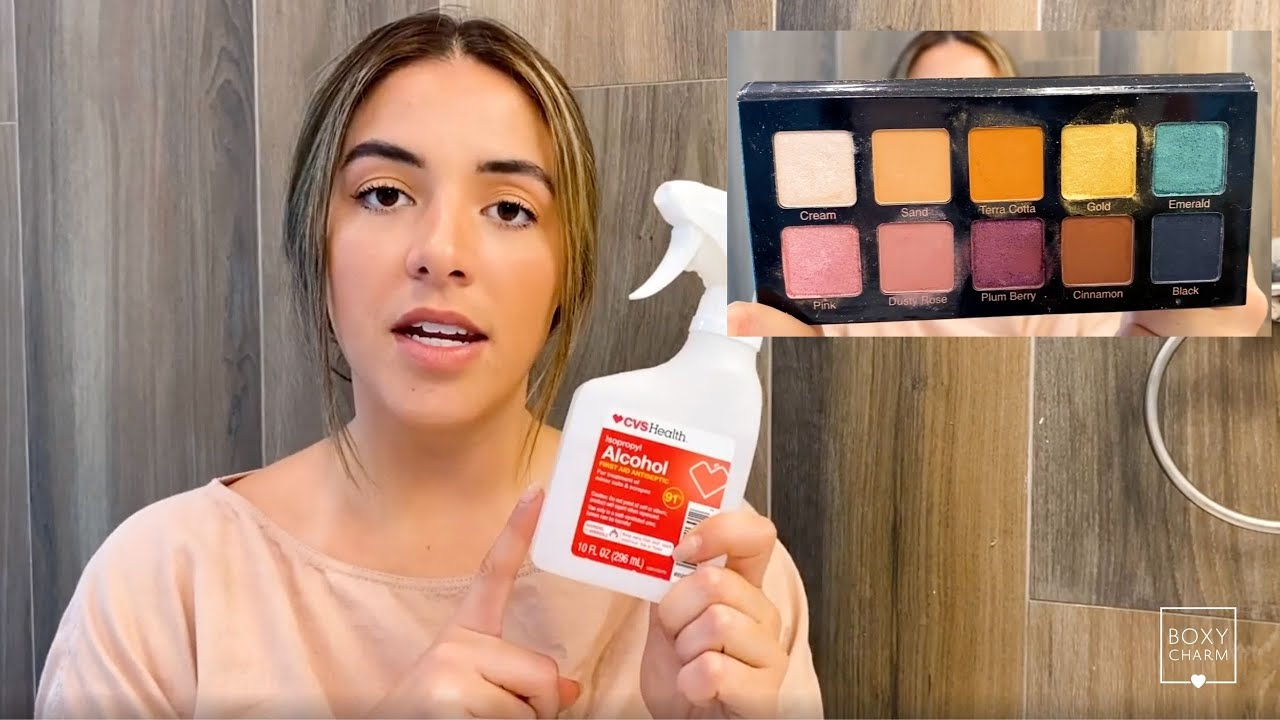
Scrape the top layer off each pan and mist it with 70% isopropyl alcohol. Then leave the palette open until everything is dry, which is the part that’s easy to rush.
Cream and liquid products need a different routine from pressed powder, and professional artists sanitize after every client.
How much the method matters shows up in a 2016 University of Nevada, Las Vegas thesis. Isopropyl alcohol on a cotton pad cut Staphylococcus aureus on inoculated eyeshadow by 99.44%. One commercial cosmetic spray managed 37.86%.
How to Clean a Pressed Powder Palette Step by Step
The order matters here, because anything wet goes on last. Fallout comes off first, then the top layer, and the alcohol only comes in after that.
What to gather

You need 70% isopropyl alcohol (the standard strength for pans), a spray bottle that gives a fine mist instead of a puddle, tissue for fallout and the top layer, and a cotton pad that only ever touches the case and mirror.
That is the whole kit. Anything wetter, like soap or a soaked cloth, stays away from the pans.
The steps
- Open the palette and wipe fallout off the lid and mirror edge with a dry tissue. Clear the pan rims while you’re there.
- Scrape or wipe the very top layer of each pan with a clean tissue.
- Fill the spray bottle with 70% isopropyl alcohol, hold it about 6 inches from the pans, and apply a fine, even mist.
- Leave the palette open and untouched while the alcohol evaporates.
- Dampen a fresh cotton pad with alcohol and wipe down the case and mirror, hinge included.
- Close the lid only when the pans and case are fully dry.
How long the pans need to dry
Pure Spa Direct, a spa and beauty supplier, tells artists to leave the palette open for at least 10 minutes after misting.
That number comes from one supplier guide and not a published test, so I’d treat it as a floor. Close the lid once the surface looks matte and the alcohol smell has gone.
There’s a safety reason to wait too. MasterClass (2022) warns that rubbing alcohol close to the eyes can cause harm, which makes a fully dry pan the safe one.
Case, mirror, and exterior

The case gets its own pad, and it goes last.
Fingerprints and dust collect on the exterior, and so does product residue, according to A Packaging Group. A separate pad keeps any of that from being carried back into the pans.
And a brush loaded with skin oil undoes the whole job the second it goes back into the powder, so washing your brushes before the next use is part of the routine.
Which Cleaning Agent Works Best on Makeup Palettes?

70% isopropyl alcohol works best on pressed powder pans. The CDC lists 60 to 90% as the optimum range for killing bacteria, and 70% sits inside it. The water in the mix helps the alcohol do its job.
| Agent | Strength | Use on palettes |
|---|---|---|
| Isopropyl alcohol | 70% | Pressed and cream pans. The default. |
| Isopropyl alcohol | 91% | Used by some artists. Slightly above the CDC range. |
| Isopropyl alcohol | 99% | Dilute to 70% before it touches a pan. |
| Makeup wipes | Varies by product | Case and mirror. Check the label for alcohol. |
| Soap and water | None | Brushes only. Never on powder pans. |
Why 70% beats 99%
The CDC’s 2008 Guideline for Disinfection and Sterilization in Healthcare Facilities puts the optimum bactericidal concentration for alcohol at 60 to 90% in water. Below 50%, killing power drops sharply.
Pure alcohol is the odd one out. The same guideline reports that undiluted ethyl alcohol kills less than an alcohol-water mix, since proteins denature faster when water is around. Suppliers such as Alliance Chemical apply that logic to isopropyl and add that 99% evaporates before the contact time is up.
So where does 91% land? The guideline puts the fall-off at 50%, not 90%, which makes 91% a small step outside the optimum range and not a failure point.
The dilution math
A Beautylish thread recommends 2 parts 70% alcohol to 1 part water. That works out to (2 x 70) divided by 3, or about 47% alcohol, which is under the 50% line where killing power starts to drop. I wouldn’t follow that one.
If you’re starting from 99% stock, measure about 354 mL of it for 500 mL of 70% (500 x 0.70 / 0.99) and top up with water to 500 mL.
If the bottle already says 70%, pour it into the spray bottle as it is. Adding water only weakens it.
The same bottle covers most of your kit, so it pays to learn how to sanitize the rest of your makeup properly.
What alcohol does not do
Alcohol doesn’t kill bacterial spores, which is why the CDC does not recommend alcohols for sterilizing. It also only treats the surface it touches, so the top layer gets scraped first.
And soap and water cleans without sanitizing, according to L Makeup Institute.
Cream, Liquid, and Shimmer Palettes Need Different Methods

Cream pans take a scrape-and-mist routine, while liquid products are protected instead of sanitized. Matte, shimmer, blush, and highlighter pans all follow the powder method.
Cream and Liquid Palettes
Idaho’s Barber and Cosmetology Services Licensing Board (rules revised July 2024) requires cake, loose, or liquid makeup in retail and makeover settings to be moved to a palette with a disinfected or single-use spatula. Leftover product on that palette gets thrown out.
Skills Competences Canada’s makeup sanitation procedure (November 2025) sets the same standard for cream and liquid products: a clean spatula, onto a clean palette.
For cream pans, scrape the surface with a disposable spatula and mist lightly with 70% alcohol, then let it dry (Pure Spa Direct). With liquid products, careful handling matters more than trying to sanitize them directly (MasterClass). Liquid eyeliner can’t be disinfected at all under the Skills Competences Canada procedure.
Stick products are a separate job, and sanitizing a lipstick follows its own steps.
Matte vs Shimmer Pressed Powders
Both finishes take the same mist-and-dry routine, since Skills Competences Canada treats powder makeup as one category that may be sprayed with 70% alcohol.
L’Oreal Paris says a wet brush dipped into certain eyeshadow formulas, often matte powders, can leave a hard film on the surface. Keep matte pans on the lightest mist. Shimmer pans follow the same routine.
Blush and Highlighter Palettes

Pressed blush and highlighter are powders, so the pressed powder steps apply unchanged.
L’Oreal Paris lists bronzer, blush, setting powder, and eyeshadow together as the powders that develop hardpan, so the scrape step is relevant to every one of them.
Hardpan, Caking, and Other Ways Cleaning Goes Wrong

Liquid pooling on the pan and oil building up into hardpan (a hard, shiny film that blocks pickup) are the two ways cleaning goes wrong. Both can be fixed, up to the point where replacing the palette makes more sense.
Removing hardpan
L’Oreal Paris traces hardpan to skin oil transferred by fingers or a double-dipped brush. A wet brush in matte powders does the same thing.
To fix it, press regular tape over the hard area and lift it off, or shave the top layer with a clean tissue like in the main routine. Either way some pigment comes off with the film.
Over-wetting and caking
Too much liquid causes both problems. L’Oreal Paris lists a wet brush in matte powders as a hardpan trigger, and a heavy spray puts liquid on the surface the same way, leaving a caked-on film.
A fine mist from about 6 inches avoids it, as long as you don’t soak the pans or close the lid over damp ones.
Plastic damage and other limits
One Sephora Community poster warns that alcohol left sitting on palette plastic can warp it. Wipe pooled liquid off the case with a tissue and keep sprays light.
A pan that stays hard after repeated scraping is a replacement question, not a cleaning one.
What Bacteria Live on a Used Makeup Palette?
Used makeup collects Staphylococcus species and fungi, along with E. coli and other Enterobacteriaceae. They get in from hands and applicators, and from surfaces too.
The best-known study of used cosmetics did not include powder palettes, so the closest evidence comes from other used products and from eyeshadow store testers.
What the studies measured
Aston University tested 467 used products in 2019, including lipstick, lip gloss, eyeliner, mascara, and beauty blenders. Between 79 and 90% were contaminated with bacteria (Journal of Applied Microbiology). Powder pans weren’t among the product types.
The older figure comes from Dawson and Reinhardt, 1981, where 67% of 1,345 eyeshadow tester samples across 15 brands carried microorganisms (Applied and Environmental Microbiology).
The two studies sit 38 years apart and measure different things, so the gap between 67% and 79 to 90% proves little on its own.
Aston’s own introduction notes that high-water cosmetics support microbial growth after in-use contamination, and lip gloss and mascara make up a large share of its sample. That likely accounts for part of the difference.
How bacteria get into the pan
The FDA points to bacteria on fingers, which is why it tells users to wash their hands before applying eye cosmetics.
Applicators matter just as much, since any instrument placed in the eye area has to be clean according to the FDA. Sponges carried the highest bacterial load in the Aston study, so cleaning makeup sponges belongs in the same routine as the pans.
Sharing is the other route. A 2017 study in Roczniki Panstwowego Zakladu Higieny (Poland) found more contamination in cosmetics used by several people than in those used by one, and products past their expiry date carried the most.
What infections follow
The FDA warns that misused eye cosmetics let dangerous bacteria or fungi grow, and that an infection can follow once the product reaches the eye. In rare cases, it reports, women have been temporarily or permanently blinded.
The AAO gives pink eye as its example of an eye infection, and says bacteria grow easily in creamy or liquid eye makeup.
That makes the cream pans in a mixed palette the higher-growth case. Dry powders offer less water to grow in, though the Aston authors frame their findings as potential risk to health, not measured infection rates.
How Often Should You Sanitize a Makeup Palette?

A palette used by one person needs a surface sanitize every few weeks. A professional kit needs one after every client, and any palette another person touches needs one before the next use.
The FDA and the AAO don’t set a cleaning interval for palettes (both focus on discarding and not sharing), so these are working rules, not standards. They follow the evidence on users: contamination rises with the number of people in the product, so the interval shortens as more hands get in.
| Situation | Interval | Basis |
|---|---|---|
| Personal palette, one user | Every few weeks | Common beauty guidance, no published standard |
| Professional kit | After every client | Pure Spa Direct, professional practice |
| Shared palette | Before each new person, with single-use applicators | FDA advice on testers, 2017 Polish study |
Clean by exposure, not by calendar
A fixed schedule misses the events that actually dirty a palette. Sanitize early if anyone else has used it or dipped a brush in. Pans that turn glossy or stop picking up color are another reason, and so is a palette that spent time somewhere damp or hot.
A single-user palette that stays clean and dry can skip the calendar entirely. Sanitizing a pan nothing has touched mostly costs you product.
When to Throw a Palette Away Instead of Cleaning It
After an eye infection, the palette goes in the trash. Same once it passes its period after opening, or if the smell, texture, or color changes. Cleaning only treats the surface.
Reading the PAO symbol
Look for an open jar icon with a number of months inside, such as 12M. That’s the period after opening (PAO). Under Article 19 of the EU Cosmetics Regulation, as Ireland’s regulator HPRA describes it, the figure comes from the product’s safety testing.
Products with a shorter shelf life carry a dated expiry mark instead, so check the packaging for either one. Write the opening date on the base with a marker so the count starts when you do (Optegra’s advice).
Formula changes the answer, and a guide to how long eyeshadow lasts covers the differences.
How long different sources allow
The AAO (August 2022) says to throw away eye makeup after 3 months. The FDA (June 2022) says manufacturers usually recommend discarding mascara 2 to 4 months after purchase. Optegra, as reported by the Yorkshire Post, gives powder eyeshadow 12 months and cream eyeshadow 6 months. The FDA also says to keep cosmetics below 85 degrees F (29 C).
The sources disagree. The AAO gives one 3-month window for all eye makeup, while Optegra splits the window by formula.
For a pressed powder palette I’d follow the printed PAO number when there is one. For cream pans, take the shorter window.
Heat is the quiet failure. The FDA says cosmetics held for long periods in hot cars are more prone to preservative deterioration, so where you keep the palette decides how fast the clock runs (see how to store makeup).
After an eye infection
The AAO says to toss all eye makeup immediately and skip it until the infection is gone. The FDA says to discard any eye cosmetics in use when the infection started. Some beauty guides suggest sanitizing the palette with alcohol instead.
Go with the AAO and the FDA. A palette in use during an infection gets replaced, not cleaned.
Signs a palette has gone bad
An unusual smell or a color change means it’s done. So does a surface that stays hard or oily after scraping.
A sealed palette is no guarantee either. The FDA notes that contamination can occasionally affect eye cosmetics even when they are new.
Makeup Palette Cleaning FAQ
What is the difference between cleaning, sanitizing, and disinfecting a palette?
Cleaning just removes visible residue. Sanitizing brings the bacteria count down, and disinfecting kills more of what’s left on the surface.
None of them gets you to sterilization. The CDC notes that alcohols lack sporicidal action, so even a well-treated pan keeps some risk.
Can you share or sell a palette after sanitizing it?
Not for eye products. The AAO says never to share eye makeup, even with family or close friends, and sanitizing lowers the bacteria count without removing it.
If you sell a used palette anyway, list it as used and say how you cleaned it.
How do you clean a silicone mixing palette?
Wipe it down with 70% isopropyl alcohol after each use. Pure Spa Direct notes that a silicone palette comes out spotless this way, and that it can also be washed in the sink with soap and water.
Move product onto it with a spatula, never a finger.
Can I use rubbing alcohol instead of isopropyl alcohol?
Yes, as long as the label lists isopropyl alcohol. Rubbing alcohol is sold in more than one strength, so check the percentage and go with 70% for pans.
Keeping a Cleaned Palette Clean
Makeup palette cleaning only lasts as long as the habits that follow it: clean hands and applicators, a closed lid, and cool, dry storage.
Wash your hands and applicators before every use, keep the lid shut, store the palette away from heat and dust, and sanitize the surface on a schedule. If you have to rank them, go by where bacteria get in, not by how easy each habit is.
Cross-contamination starts at contact, and storage decides whether anything multiplies once it’s there. Sanitizing just resets the surface.
The cost is convenience, since brushes replace fingers and nobody borrows the palette.
As of October 2026, intervals for personal pressed palettes rest on studies of other used products and eyeshadow testers, so a culture study of palettes in home use would change them.
Brushes touch every pan on every use, so deep cleaning makeup brushes is the natural next job.

She started writing on the site after fielding the same questions from clients and friends often enough to just write the answers down: which red won't turn orange on a warm undertone, how to keep lipstick from feathering into fine lines, why a "12-hour" formula rarely survives dinner.
Every review on the site follows the same rule she uses with paying clients: wear it first, then decide if it's worth recommending.
- How to Make Eyeliner Last Longer Without Smudging - August 31, 2026
- How to Make Eyeshadow Last Longer All Day - August 29, 2026
- How to Find Your Undertone in 5 Easy Steps - August 27, 2026