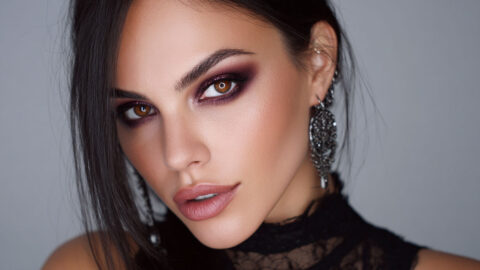
To curl eyelashes without a curler, hold them upward against a warm metal spoon, a spoolie, a mascara wand, a cotton swab or a clean finger for 5 to 30 seconds, then coat them in mascara so the shape sets.
The curl lasts a day at most. Only a salon lash lift holds for weeks, and that means a chemical treatment near your eye.
Mascara is what locks the shape in, and it isn’t free of downsides. A 2014 Journal of Cosmetic Science study scanned eyelashes from 36 women with X-ray microscopy. Cuticle cracking tracked with how often they wore mascara, while curler use had no statistically significant effect.
Which methods curl eyelashes without a curler, and how do they compare?

You can shape lashes with curling mascara, a spoolie, your fingers, a cotton swab, a warm metal spoon or a salon lash lift. Everything on that list except the lift wears off within a day.
| Method | Tool | Hold at the lashes | Heat |
|---|---|---|---|
| Curling mascara | Wand and formula | 10 seconds at the base, 5 at the tips | None |
| Spoolie, fingers or cotton swab | Clean brush, hands or swab | 10 to 30 seconds | None (brush can be warmed) |
| Warm spoon | Small metal spoon | 10 to 30 seconds | Warm water or blow dryer |
| Lash lift | Salon perm solution | 4 to 8 weeks | None (chemical) |
Hold times come from Silly George (2021), Sixty and Me (2023) and MasterClass (2022). Silly George and Sixty and Me give counts of 10 to 30 seconds. MasterClass only says to hold for a few seconds, so the table shows the range the counts cover. Lash lift hold comes from the AAO (2019) and Healthline (2022), and MasterClass is the outlier here, claiming perms last up to three months.
Curling mascara carries the lowest risk, since there’s no heat and nothing to use beyond the wand. If you want to shape bare lashes, a spoolie or a warm spoon goes on before any product does. The lash lift holds longest, though a Cleveland Clinic ophthalmologist (2023) recommends a regular curler over it.
No published test compares curl angle across these methods. The ranking above rests on risk and on the hold times each source gives.
Should you curl lashes before or after mascara?
Before, for any method that reshapes bare lashes. The mascara coat then dries into the new shape and works like a fixative.
The sources split on this, and the split has a reason.
Some of them shape first and coat second.
- Sixty and Me runs five of its six techniques on bare lashes and applies mascara only afterward.
- The same piece warns that using an eyelash curler over mascara can make lashes break off.
- Lancome’s guide puts a warm spoon or warmed-finger step ahead of its curling mascara.
Others do it the other way around. Silly George presses lashes upward with the wand right after a first coat and holds 10 seconds at the base. Typology applies mascara first for its cotton swab method and repeats the press until the coat dries. Sixty and Me’s sixth technique holds a finger against the lashes after the mascara goes on, until it dries.
What holds the shape explains the disagreement. Spoons and spoolies bend the hair itself, so they need a coat afterward. Wand and swab methods bend lashes while the formula is still wet and rely on it drying in place.
The rule that reconciles both is to press only bare lashes, or a coat that hasn’t dried yet. Dried mascara stiffens the lash, and that’s where the breakage reports come from.
Prep doesn’t change either way. Remove old mascara with an eye-safe oil remover (Typology’s advice) and dry the lashes fully. Wash your hands, and keep every tool clean (FDA eye cosmetic guidance).
How to curl eyelashes with curling mascara and a wand

Curling mascara lifts lashes by drying in an upward shape, with the wand doing the bending while the formula is still wet.
Wand control matters more than the formula, so it pays to know the basics of applying mascara before adding the press.
- Start with clean, dry lashes. Shape them with a spoolie first if you want extra lift.
- Load the wand and set it at the lash roots, angled upward.
- Wiggle the wand side to side at the base, then sweep up through the tips.
- Press the lashes up with the wand and hold 10 seconds at the base. Move to the tips and hold 5 seconds.
- Let the coat dry before you blink, then add a second coat to lock the shape.
Which formula holds a curl
A curling mascara has a brush and formula built to lift. Maybelline sells its Colossal Curl Bounce with a Memory Curl formula that the brand markets for 24-hour wear.
Tubing mascara works differently. Polymer sleeves form around each lash and hold up against humidity and sweat, and against tears as well. Warm water and light pressure loosen them at night, per Clinique and Mirenesse.
Waterproof formulas hold in humid weather too, but they need an oil-based remover.
Clinique claims its tubing formula lifts lashes by 50% and holds for 24 hours. That’s a brand claim. The product page footnotes it to clinical testing on 11 women after 24 hours of use and gives no further test method.
Where wand curling goes wrong
Clumping is the usual failure. Heavy coats glue lashes together and pull the curl down, so it helps to fix a clumpy coat before it sets.
Old formula is the quieter problem. The AAO says to throw away eye makeup three months after purchase, and the FDA’s shelf-life Q&A (content current as of February 2022) notes that some industry experts recommend replacing mascara three months after purchase. The FDA’s eye cosmetic safety page puts the usual manufacturer range at two to four months.
Daily wear costs something as well. The Journal of Cosmetic Science study that imaged eyelash interiors found cuticle cracking tracked with how often volunteers wore mascara, and did not track with curler use.
How to curl eyelashes with a spoolie, your fingers or a cotton swab
None of these adds heat. Each presses the lashes upward for 10 to 30 seconds, and each holds better once mascara seals the shape.
Spoolie

- Use a clean, dry spoolie. MasterClass also accepts an unused toothbrush, and suggests warming the bristles in hot water and drying them on a towel first.
- Set the bristles behind the lashes at the underside base, turn slightly upward, and press.
- Hold 30 seconds (Sixty and Me), then seal with a waxy mascara.
Buildup on the bristles stiffens them and carries bacteria to the lash line, which is why keeping a spoolie clean between uses matters.
Fingers
Press a clean finger flat across the lashes and push them gently up and back. Hold about 30 seconds, per Sixty and Me. Wash your hands first, as the FDA advises for anything near the eyes.
It’s a quick fix before a coat of mascara. Skip the coat and the shape has nothing to lock it.
Cotton swab
Do the mascara first, while the coat is still wet. The swab then sits at the base of the upper lashes, against the lid (Typology).
Silly George (2021) holds 10 to 20 seconds. Typology says about 30 seconds per press and repeats the press until the coat dries.
How to curl eyelashes with a warm spoon

A warm metal spoon bends bare lashes upward over its rounded back. Every source repeats the same limit, which is warm and never hot enough to burn.
- Set a small metal spoon in a cup of warm water for at least three minutes (MasterClass), or warm it with a blow dryer.
- Dry the spoon on a clean towel and touch it to a finger first.
- Rest the rounded back of the bowl against the lash roots, bowl facing away from your face.
- Press the lashes up and back against it with a thumb or finger. Silly George holds 10 to 20 seconds, Sixty and Me holds 30.
- Work from base to tips in short passes, then seal with mascara.
Warm water or blow dryer
Warm water is the safer route because the spoon can’t get hotter than the water. A blow dryer warms faster but overshoots easily, and a Beautylish thread (user reports, not a test) says to stop at barely warm.
No source publishes a temperature. The finger test in step two is the only check you get.
What works and what doesn’t about the spoon
It costs nothing, and it puts no product on the lashes before mascara. Beautylish users report a curl that lasts all day.
The downsides are real, though.
- Heat sits close to the lid, and no safe temperature has been published.
- Pulling while pressing can tug lashes, so MasterClass says to pull gently.
- The shape stays temporary until mascara seals it.
Choosing a method by lash type

The method should match the lash problem. Short lashes need lift at the roots, straight ones need a bare-lash shape plus a formula that grips, and thin ones need low-force methods.
- Short lashes do best with a press at the base, using the wand’s root press or a spoon resting against the lash line. Sixty and Me (2023) points out that pointing lashes up rather than straight out is what makes them look longer.
- For straight, stubborn lashes, shape them bare with a warm spoon or spoolie, then seal with a waterproof formula. The same article ties day-long hold on very straight lashes to the mascara formula itself.
- Thin or sparse lashes should stay with the no-heat methods and skip any pulling. Sixty and Me notes that lashes get thinner and shorter with age, and there are fewer of them, which leaves less hair to take strain.
- Downward-growing lashes are easier in sections, because the same source repeats its press at the outer and inner corners so those lashes get a separate pass.
These pairings are reasoning drawn from the method sources. No study tests curler-free methods by lash type.
Is a lash lift a safe way to curl lashes without a curler?
A lash lift suits an occasional salon visit and fails as a home project. A chemical rearranges the bonds inside each lash, which is why clinical sources ask for a trained technician and a patch test.
A lash perm coats the lashes in adhesive, curls them around rollers, then treats them with chemical solutions, according to the American Academy of Ophthalmology (2019).
The lift is a bit different. Lashes are combed onto a silicone shield and held with adhesive while a chemical lotion breaks down the protein in each one (AAO, 2019). Cleveland Clinic (2023) describes the same step as breaking down and reorganizing disulfide bonds.
Keratin lifts swap the usual wand for a silicone rod covered in keratin, and a serum sets it, per Healthline (2022).
Time, hold and cost
A session takes about 45 minutes, with the perm solution sitting for roughly 15 of them (Cleveland Clinic, 2023). Healthline (2022) puts the hold at 4 to 6 weeks, while the AAO gives 6 to 8 weeks for a lift and 1 to 2 months for a perm (2019). Expect to pay around $100 per lift session (AAO, 2019).
Pros and cons
The appeal is easy to see. There’s no daily tool or product, which gives your lashes a break from mascara (Healthline). One visit buys weeks of hold, and it works with the lashes you already have.
The risks sit mostly on the allergy and overprocessing side.
- Allergic reaction, with redness and swelling or a rash (Cleveland Clinic)
- Reactions can appear after earlier treatments went fine, says AAO spokesperson Purnima Patel, MD (2019)
- Repeated processing weakens lashes, per a UK Trading Standards factsheet
- Higher risk of eyelid inflammation and infection, with limited research on long-term effects (Cleveland Clinic)
The lift doesn’t add length either. Cleveland Clinic’s ophthalmologist, Nicole Bajic, MD, says the curl only makes lashes look longer.
Where the sources disagree
Duration is the obvious split. Healthline gives 4 to 6 weeks, the AAO gives 6 to 8, and MasterClass sits above both. Treatment type, aftercare and each person’s lash growth account for most of the gap, which Healthline says outright.
Damage splits too. Healthline says a lift should not harm lashes, while Cleveland Clinic and the Trading Standards factsheet warn that overprocessing weakens them.
The positions fit together once frequency enters. One visit is a small exposure, and the AAO’s Dr. Patel says sensitivities build with repeated exposure.
Aftercare advice differs as well. Healthline says to keep lashes dry for 24 to 48 hours, while Cleveland Clinic’s ophthalmologist calls advice not to clean around the lashes bad advice that can lead to infection. She names no time limit, so it’s unclear whether she would object to a short initial dry period.
Keeping the curl and taking it off

A curl drops when oil or moisture reaches the lash, or when you rub your eyes. It comes off cleanly only when the removal method matches the formula.
Keeping the curl through the day

Healthline’s lash lift aftercare names oils and eye rubbing as the habits that shorten a curl. Both work against a mascara curl as well. Keep oil-based eye products away from the lash line, and pat an itchy lid with a clean fingertip instead of rubbing.
No independent test measures curl hours for these methods. The hour figures that exist are brand claims.
Taking it off
Bare-lash methods leave nothing to remove. Spoon, spoolie and finger shaping leave no residue until mascara goes on top.
Tubing mascara comes off with bath-temperature water splashed on the lashes several times and gentle pressure from fingertips, per Clinique. A warm wet cotton pad held on the closed eye works too. Mirenesse says to allow about half a minute, and warns that dry lashes leave the tubes gripping.
Waterproof formulas need an oil-based approach, and a walkthrough on taking off waterproof makeup covers the technique. Keep remover out of the eye itself, as AAO guidance advises.
Standard curling mascara is simpler. Use any gentle eye-area remover, then run a clean cotton swab along the lash base to lift the last residue, a step the AAO recommends in its eye makeup safety tips.
Nothing should stay on overnight, since the AAO says to remove all eye makeup before bed. A full eye makeup removal routine keeps the lash line clean without rubbing.
Safety limits and when a regular curler is the better call
Curler-free methods swap clamp pressure for heat, product and contact time, and each of those has a hard limit.
- Never separate clumped lashes with anything sharp (AAO).
- The FDA says never to apply or remove eye cosmetics in a moving vehicle.
- Pulling lashes while pressing breaks hairs, and MasterClass notes that a misused regular curler can tear lashes out as well.
- Stop using any eye cosmetic that irritates (FDA), and throw out all eye makeup after an infection (AAO).
When a regular curler is the better call
Cleveland Clinic’s reasoning (2023) comes down to chemistry. A curler presses a lash temporarily, while a lift alters it.
That doesn’t make the curler harmless. Kose and Milbon presented research at the Fibre Science Society Research Conference in November 2023 that found cuticle damage under an electron microscope in lashes treated by curlers and by chemical curling.
The damage was most noticeable in the chemical group, and protein leaked from the most severely damaged lashes, according to CosmeticsDesign-Asia’s January 2024 report.
| Situation | Better call | Basis |
|---|---|---|
| Curl most days | Curler-free methods, or a padded curler on bare lashes, not daily | Lash expert quoted by Hello! (2023) |
| One or two events a year | Salon lash lift with a patch test | Cleveland Clinic, 2023 |
| Needs a stronger, repeatable curl | Padded curler on bare lashes | Lash expert quoted by Hello! (2023) |
A curler you already own needs worn pads replaced, because a worn or damaged pad can cut lashes, per the lash expert Hello! quoted. Residue builds up as well, so sanitizing a curler belongs in the routine.
When to stop and get help
Redness or swelling, or a rash after any treatment, is reason enough to stop. So is eye pain or a change in vision. If you react to a product, the AAO says to report it to the FDA so it’s on record.
Curling Eyelashes Without a Curler FAQ
Does a heated eyelash curler count as a curler-free method?
No. A heated eyelash curler is still a clamp with added heat, built for a stronger curl (MasterClass, 2022).
Some models add a grooved guard and temperature settings so the hot pad stays off the lid, but the tool needs a steady hand.
Can aloe vera or castor oil curl lashes?
Aloe vera gel can hold a light curl. Press the lashes upward and hold a few seconds while it sets, per MasterClass (2022).
Castor oil conditions lashes. Typology says it can set a curl the way aloe gel does, but cites no test, and the Sixty and Me author reports seeing no change in lash length or fullness after using it.
Will a lash serum curl eyelashes?
Not by itself. A serum conditions the lash, while the curl still comes from pressing and setting it.
Lancome’s guide lists serum as a support step without test data for curl, so read up on what lash serum is designed to do before expecting more.
Is it safe to curl lashes with a hair curling iron?
No. Sources that give heat guidance cap it at warm, and none publishes a safe iron temperature for the eyelid.
A warmed spoon or brush is the tested route. A hair iron has no sourced setting near the eye.
Which Method to Try First and When to Switch
Start with the mascara wand, move to a spoolie or finger press if that fails, and leave the warm spoon for last. The wand press goes on a wet coat, the spoolie or finger press goes on bare lashes, and the spoon only comes out after both have let you down.
That order runs from tools that never carry heat to the one that does, so a failed first try costs you nothing. If a method drops its curl after two correctly timed attempts, replace it instead of repeating it.
A lash lift can’t carry the whole year. At 4 to 8 weeks per lift (Healthline, 2022; AAO, 2019) and two visits a year, a frequency Cleveland Clinic’s ophthalmologist says is unlikely to cause significant damage (2023), it holds the curl for 8 to 16 of 52 weeks. That leaves at least 36 weeks to curler-free methods.
Once the curl holds, building the rest of an eye makeup look is the next step.

She started writing on the site after fielding the same questions from clients and friends often enough to just write the answers down: which red won't turn orange on a warm undertone, how to keep lipstick from feathering into fine lines, why a "12-hour" formula rarely survives dinner.
Every review on the site follows the same rule she uses with paying clients: wear it first, then decide if it's worth recommending.
- How to Make Eyeliner Last Longer Without Smudging - August 31, 2026
- How to Make Eyeshadow Last Longer All Day - August 29, 2026
- How to Find Your Undertone in 5 Easy Steps - August 27, 2026