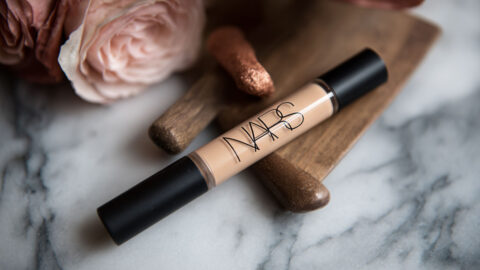
The way you apply NARS liquid blush depends on which formula you own. Afterglow comes in a tube, and the directions say to wash it on from the back of your hand or put two dots straight onto the cheeks. The original comes in a pump bottle, and you warm a small amount in your palm first.
After that the routine is mostly the same. Tap the blush onto the apples of the cheeks with your fingers or a fluffy brush, blend toward the hairline, and build it in thin layers over a liquid or cream base.
NARS launched a pump-bottle liquid blush in 2017 and followed it with the doe-foot Afterglow in 2023. They differ in size, at 0.5 oz against 0.23 oz (Musings of a Muse, 2023), and in their official directions.
How to Apply NARS Liquid Blush Step by Step

The steps are the same for both formulas. Only the amount changes.
- Finish your base first. Moisturizer and foundation go on before the blush, with concealer too if you wear it, because liquid formulas sit best over a liquid or cream base (MasterClass).
- Dispense onto the back of your hand. On Afterglow that means the doe-foot wand. On the original, pump a small amount into your palm and warm it with your fingertips.
- Tap onto the apples of the cheeks. Fingers give a natural flush, and a fluffy brush gives a stronger one.
- Blend out toward the hairline with light pressing and tapping.
- Build in thin layers, adding a second coat only once the first one is blended.
- Sweep powder blush over the top if you want more impact. NARS lists this as the last step in its Afterglow directions.
NARS Director of Pro Artistry and Red Carpet Rachel Goodwin shows the same two moves in the NARS tutorial: tapping onto the cheekbones with fingers or a blush brush, then blending out toward the hairline.
Tap, don’t swirl. A tip posted in the NARS community warns that swirling a brush over a base that hasn’t set can break the makeup apart.
It also helps if your skin is moisturized and prepped before makeup, since the blush then has an even surface to settle into.
If your base is NARS foundation, the routine for applying NARS foundation covers that step before the blush goes on.
What Changes When You Apply the Original Pump Formula or the Afterglow Tube

The original is a pump bottle and Afterglow is a tube with a doe-foot wand, and the dispenser decides how you dose the product.
| Feature | Original Liquid Blush | Afterglow Liquid Blush |
|---|---|---|
| Launch | May 2017 | Summer 2023 |
| Dispenser | Pump bottle | Tube with doe-foot wand |
| Size | 0.5 oz (15 ml) | 0.23 oz (7 ml) |
| Care ingredients | Monoi and Tamanu oils | Sodium hyaluronate, 8-hour hydration claim |
| Shades | Orgasm, Luster, Torrid, Dolce Vita | Orgasm, Behave, Dolce Vita, Wanderlust, Brazen, Insatiable (more added since) |
Launch dates and sizes come from Refinery29 (2017), The Beauty Look Book (2017), Musings of a Muse (2017 and 2023) and the NARS product pages.
The pump lets you take anything from a drop to a full pump, while the wand deposits dots. Beautycrew (2023) calls the original a classic liquid blush and Afterglow a skincare-makeup hybrid with a dewy finish.
Reviewers disagree on color payoff. Musings of a Muse found Afterglow easier to build and better in payoff, while The Beauty Look Book found the original has a lot more color payoff (both June 2023).
Liquid sits next to powder and cream in the NARS blush range, and each of those blush formats wears differently.
Shade names overlap, which causes buying mistakes. Torrid and Luster exist only in the original formula. Behave, Wanderlust, Brazen and Insatiable exist only in Afterglow, along with the later Orgasm Rush, Secret Lover and Aragon.
Orgasm and Dolce Vita appear in both.
As of October 2026, the NARS US tutorial page for the original formula shows Torrid as final sale and out of stock. Confirm which formula a shade belongs to before you buy it.
How Much NARS Liquid Blush to Use on Each Cheek

Afterglow tops out at two dots directly on the cheeks. The original pump runs from a single drop to one full pump.
Thin layers beat one heavy dose with either formula, which fits the general approach to liquid blush application.
Afterglow Dosing
For a second-skin wash, deposit product on the back of your hand and tap one coat onto the cheeks with your fingers. Tap a second coat over the first and it reads as natural color.
For a bold rush, put two dots straight onto the cheeks with the wand and blend with your fingers.
Keep layering until the color reads right, then sweep powder blush on top to strengthen it. The NARS directions give this same sequence.
Original Pump Formula Dosing
NARS copy says one pump delivers the right amount of natural-looking color. PureWow’s reviewer, wearing Torrid, used half a pump or less for both cheeks.
The formula is concentrated, and retailer Lyko’s product copy puts the range at anything from a drop to a full pump, depending on the intensity you want.
I’d start with half a pump for both cheeks and add a drop at a time from there.
Where to Place NARS Liquid Blush for a Natural or Lifted Look

For a natural flush, put NARS liquid blush on the apples of the cheeks. Moving it up onto the cheekbones and blending toward the hairline gives stronger color that carries into the evening.
To find the apples, smile and tap onto the rounded part with your fingers. For the cheekbone version, pick the blush up with a brush and blend outward. The NARS tutorial itself pairs fingers with the apples and a brush with the stronger, more pigmented version.
NARS’s Orgasm powder blush page adds two more placements. Under the cheekbone, blended outward and upward, gives a sculpted look, and a C shape worked upward gives a lifted one.
Those directions are written for powder, so treat them as general blush placement and not as liquid-specific rules.
Face shape changes where blush reads best, and this guide to blush placement on different face shapes goes through each one.
Start at the apples. You can always move color upward, but pulling it back down is harder.
Choosing Between Fingers and a Brush for NARS Liquid Blush

Fingers give a natural, second-skin finish and a fluffy brush gives stronger color. Sponges work too, but NARS’s own directions only name fingers and brushes.
| Tool | Strengths | Drawbacks |
|---|---|---|
| Fingers | Body heat melts the formula in | Color ends up on your hands |
| Fluffy brush | Stronger, more pigmented result | Dense bristles are the wrong pick |
| Sponge | Taps product on from the back of the hand | Not part of NARS’s own directions |
L’Oreal Paris credits the heat of your fingertips for melting liquid blush into the skin, and says fingers are good at building pigment.
Kotofuku’s product copy for Afterglow suggests finishing with a blush brush to keep color off your hands.
PureWow’s reviewer used a fluffy brush, not a densely packed one. A small stippling brush concentrates the blend, per L’Oreal Paris, and the basics of applying makeup with a brush carry over.
A tip in the NARS community says to put the blush on the back of your hand first and tap it onto the brush or sponge. That keeps the dose small and the blend seamless.
For the pressing motion itself, the general method for applying makeup with a sponge applies here.
Circular motions are where the sources split. L’Oreal Paris blends a stippling brush toward the hairline in circles, while the NARS community tip warns that swirling can break apart a base that hasn’t set.
So small circles are fine on a set base, and taps are the safer move on one that hasn’t set yet.
I’d start with fingers and only bring in a brush when the color needs more.
Does NARS Liquid Blush Go Before or After Foundation and Powder?
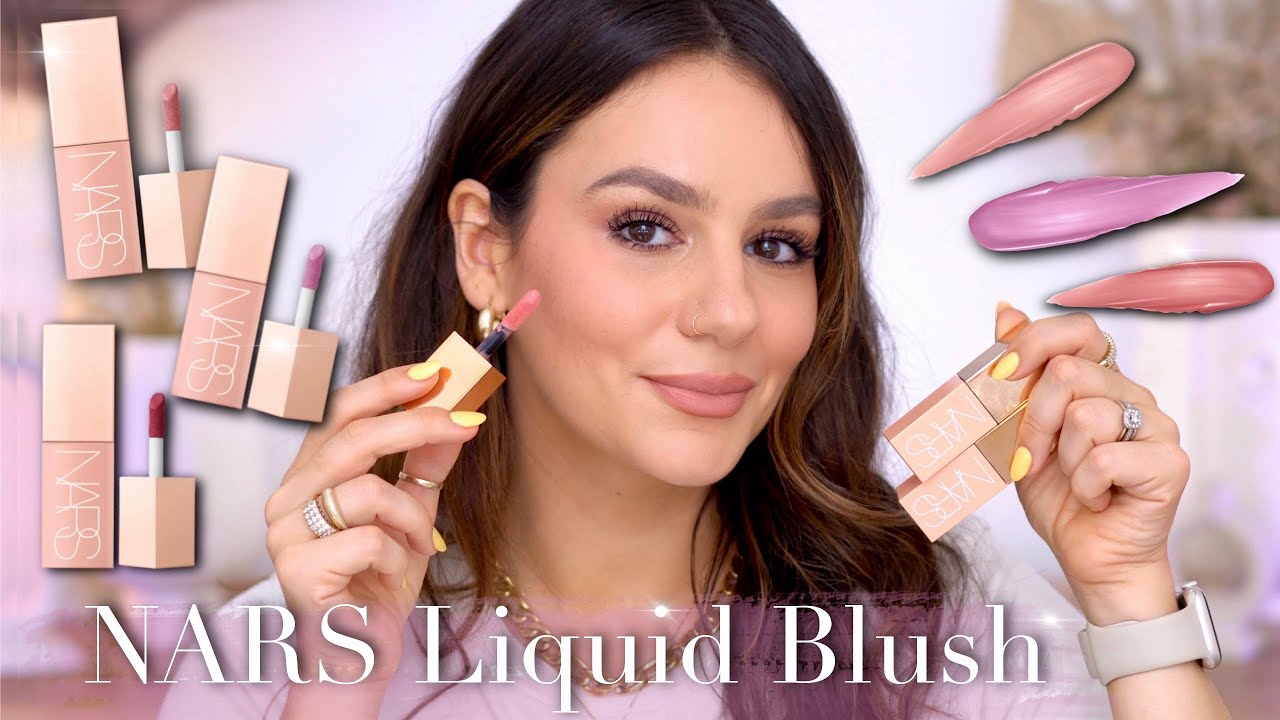
The standard order is after liquid foundation and concealer, with powder blush either swept on top to deepen the color or placed underneath without killing the glow.
Powder over liquid intensifies color and adds dimension, per the NARS directions for both formulas. Feelunique’s copy for the original pump formula says liquid over powder blush gives high-impact color, and liquid applied first gives a diffused effect.
MECCA’s product copy calls Afterglow in Orgasm great under and over powder. One Feelunique reviewer puts face powder on the first blush layer before adding the second, and still gets a dewy look.
The base order isn’t settled either. MasterClass puts blush after foundation, while a NARS community routine dabs liquid blush on first, then applies foundation with fingers and a Beautyblender, then concealer and powder blush.
Base first is the safer default. Blush first is an alternative some NARS community members use.
The same logic holds across a full face, which this guide to layering makeup lays out step by step.
A NARS community artist finishes her routine by topping liquid blush with powder blush in the same spot, then locks it with setting spray. The method for applying setting spray matters as much as the product.
Which NARS Liquid Blush Shade Suits Your Skin Tone?

Pick by color family first and depth second. Orgasm, Brazen and Torrid are coral and peach shades, so they run warm. The mauve and lilac ones, Behave and Wanderlust, run cool.
| Shade | Formula | Color (NARS) | Reported fit |
|---|---|---|---|
| Orgasm | Both | Peachy pink, golden shimmer | Cult Beauty copy calls it universally flattering |
| Behave | Afterglow | Mauve pink | A reviewer finds it perfect for medium skin |
| Dolce Vita | Both | Dusty rose | Shows up on lighter olive skin (NARS UK review) |
| Torrid | Original | Warm coral, golden shimmer | Flatters warm undertones (Cult Beauty review) |
| Aragon | Afterglow | Warm chestnut brown | Reads redder than brown (Ulta reviewer) |
NARS Germany lists nine Afterglow shades as of October 2026. Beyond the table, Wanderlust is a soft lilac, Brazen a coral peach, Insatiable a deep plum, Orgasm Rush a rosy bronze and Secret Lover a watermelon pink.
Judge the shade after blending, not in the tube. A Cult Beauty reviewer says Dolce Vita looks dark pink in the bottle and blends to a fresh glow, and an Ulta reviewer says Aragon looked really dark at first and blended out to almost nothing.
For deeper skin, a review on narscosmetics.com says the original formula looks amazing on darker skin tones. By description, Aragon and Insatiable are the deepest Afterglow shades.
Undertone and depth rules that apply to every product are covered in this guide to matching makeup to your skin tone.
Fixing Streaks and Other Problems With NARS Liquid Blush

Most problems come from the base underneath or the dose on top, not the formula, since NARS sells Afterglow as a blush that layers and blends without streaking.
Streaks and a Broken-Up Base
Streaks usually start with swirling over a base that hasn’t set, or with dragging a heavy dose across the cheek instead of tapping. Stacking a second layer before the first is blended does it too.
Tap with a clean fingertip until the edge disappears, and build in thin coats. Keep blending before reaching for more product.
When the base has already lifted, the steps for fixing patchy makeup cover the recovery.
Wear Time and Skin Type

Musings of a Muse recorded 12 hours of wear from Afterglow without fading. The same review says the formula doesn’t accentuate pores or cling to drier skin.
MasterClass calls liquid blush the most hydrating blush type for dry skin, and a Feelunique reviewer in her 60s finds it more flattering than powder. Faith Xue of BDG, who has an oily T-zone, wrote in The Zoe Report that the serum-like formula sinks in instead of slipping or transferring.
If you want a matte finish, Cult Beauty describes the original Dolce Vita as matte dusty rose, while NARS describes Afterglow as luminous.
Finish descriptions disagree. NARS and Beautycrew (2023) call Afterglow luminous and dewy, while Musings of a Muse says it sets to a smooth, silky finish that isn’t dewy, and Really Ree calls it not overly dewy but not matte.
If dry patches show under the base, the steps for applying makeup on dry skin fix that before the blush goes on.
Leaks and Mess
The pump on the original formula is the weak point.
NARS says to pull the cap straight off, because twisting can remove the enclosed pump with the cap. NARS UK reviewers report a stuck pump and spilled product after twisting.
A Cult Beauty reviewer calls the formula very liquid and messy, and another says it leaks.
Afterglow’s tube has no pump to dislodge.
NARS Liquid Blush FAQ
Does NARS liquid blush work on bare skin?
Yes. A Sephora UK reviewer says the Afterglow Liquid Blush Duo works on both bare skin and over foundation.
A review on narscosmetics.com still recommends well-prepped, moisturized skin for the most seamless finish.
Can you mix two NARS liquid blush shades?
Yes. A Cult Beauty reviewer blended Behave and Wanderlust for a natural flush of color.
Mix them on the back of your hand, not on the face, so you can judge the color before tapping it on.
Is the original pump formula still sold?
No retrieved source confirms a discontinuation. Retailers list original shades such as Torrid and Luster as sold out, so availability depends on where you shop.
Check NARS directly before ordering a specific shade.
Which NARS liquid blush is vegan?
Afterglow. John Lewis lists it as a vegan formula, and Notino states it contains no ingredients of animal origin.
The retailer listings for the original pump formula don’t state its vegan status.
Which NARS Liquid Blush to Buy First
Afterglow in Orgasm or Dolce Vita is the safest first NARS liquid blush, because the doe-foot wand doses in dots and both shades also exist in the original pump formula.
Musings of a Muse (2023) prices both formulas at $32. That works out to about $2.13 per ml for the 15 ml pump bottle against $4.57 per ml for the 7 ml Afterglow tube, a gap neither listing states on its own.
The trade-off is simple. You pay roughly twice as much per ml for the easier wand, or you accept scarcer shades for the larger bottle.
Judge any new shade after blending two thin coats over your usual base, since both formulas build from sheer to bold.
Everything here was checked in October 2026. Retail stock of original-formula shades shifts, so confirm availability before building a routine around Torrid or Luster.

She started writing on the site after fielding the same questions from clients and friends often enough to just write the answers down: which red won't turn orange on a warm undertone, how to keep lipstick from feathering into fine lines, why a "12-hour" formula rarely survives dinner.
Every review on the site follows the same rule she uses with paying clients: wear it first, then decide if it's worth recommending.
- How to Make Eyeliner Last Longer Without Smudging - August 31, 2026
- How to Make Eyeshadow Last Longer All Day - August 29, 2026
- How to Find Your Undertone in 5 Easy Steps - August 27, 2026