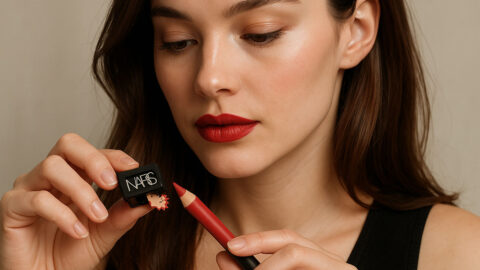
To sharpen a NARS lip pencil, wipe the blade of the NARS Pencil Sharpener with alcohol and push the jumbo barrel into the larger opening. Then twist clockwise with light pressure until the tip tapers.
Velvet Matte and Powermatte pencils don’t twist up. The sharpener is the only way to get at fresh product.
NARS says in its own product copy that other sharpeners may be harmful or damaging. Shopper reviews on Ulta and Space NK back that up, with people describing thick pencils that split the wood or snap the nib in generic blades.
Do NARS lip pencils need to be sharpened?
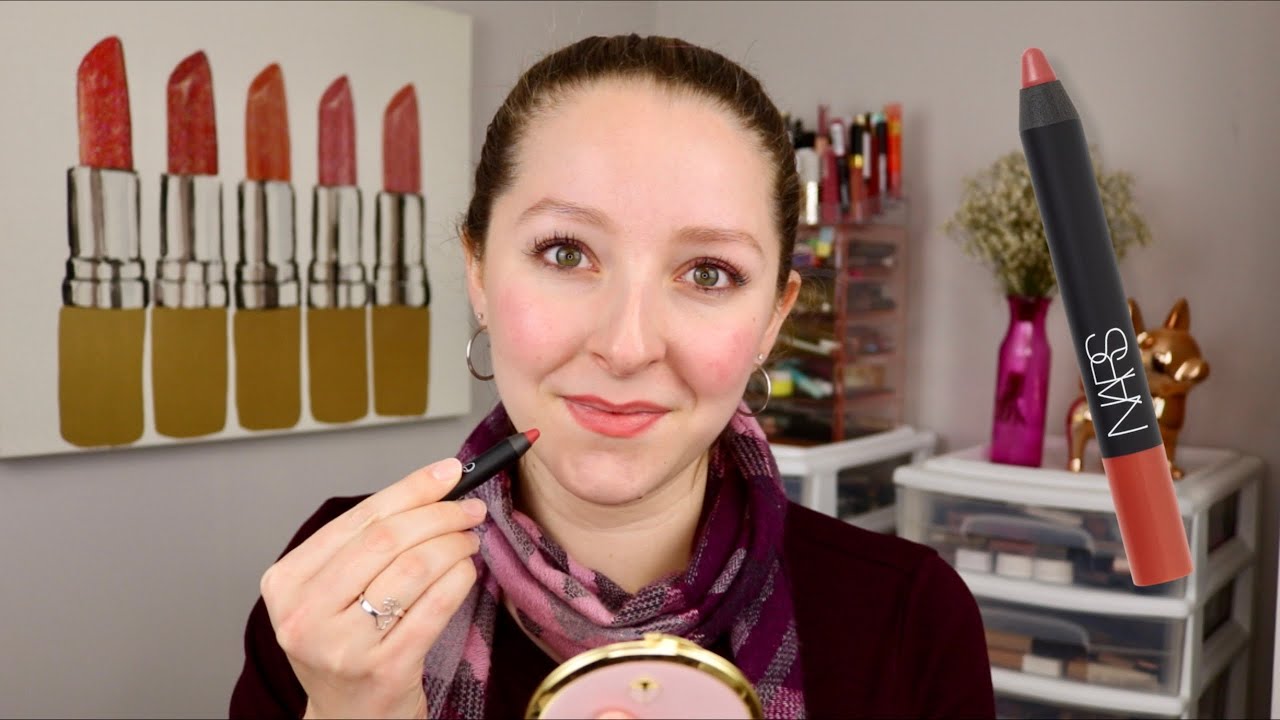
Yes. A NARS lip pencil does not twist up, so sharpening is the only way to expose fresh product.
People get stuck on this more than you would expect. In a Sephora Community thread, someone who bought two Velvet Matte pencils twisted the barrel until their hands hurt, and the replies pointed them to the NARS Pencil Sharpener.
Which NARS pencils are sharpenable

- The Powermatte High-Intensity Lip Pencil, where NARS retail copy says to sharpen it before each use and sells the sharpener separately
- The new 2026 Lip Liner, which NARS describes as having a sharpenable wooden tip and says to use the Pencil Sharpener before each application
- The discontinued Velvet Matte Lip Pencil, which NARS said works best with the NARS Pencil Sharpener (leftover stock may still turn up at some retailers)
- The Velvet Gloss Lip Pencil, called a jumbo pencil that needs sharpening and is not a twist-up in a 2012 review on Lola’s Secret Beauty Blog
The casing has changed over the years. The same Sephora thread notes the newer pencils look plastic next to the older ones, and one reply confirms both versions are made to be sharpened.
NARS described the Velvet Matte as a jumbo pencil with a tapered end for lining, defining and filling in lips.
The Velvet Matte formula aimed for the finish of a matte lipstick, with silicones holding the color and vitamin E plus emollients keeping the texture creamy.
A tapered tip only stays tapered if you keep sharpening it, so the tool you use matters.
Which sharpener works best for a NARS lip pencil?

The NARS Pencil Sharpener is the safest pick, because NARS recommends it for its own pencils. A dual-opening cosmetic sharpener is the fallback, and it only works when the large opening fits the barrel.
| Option | Jumbo fit | Shavings and cleaning | Main drawback |
|---|---|---|---|
| NARS Pencil Sharpener | Removable adapter resizes the opening | Cover and blade cleaner included | Sold separately |
| Dual-opening cosmetic sharpener | Large opening, check barrel width first | Varies by brand | Not matched to NARS pencils |
| Standard single-hole sharpener | Sized for standard pencils | Varies by brand | Wrong size for jumbo barrels |
NARS Pencil Sharpener
The sharpener lists at $7.00 on the US NARS site.
It has two blades and a removable adapter that resizes the opening for the largest pencils, and the box includes a blade cleaner and a cover (NARS). Cult Beauty describes two sharpening holes, one for standard pencils and one for larger ones.
NARS says the tool is designed for its lip and eye pencils, which is why the steps for sharpening NARS eyeliner use the same sharpener.
NARS artists answering shopper questions on Ulta confirmed it handles the High-Intensity Lip Pencils too.
It copes with both jumbo and standard barrels, and the cover keeps the shavings from going everywhere. The downside is that you have to buy it separately, and a 1-star Feelunique review of the Powermatte pencil complains about exactly that. One Cult Beauty reviewer also finds it hard to clean.
Generic and dual-opening cosmetic sharpeners
Brand copy and forum advice disagree here.
NARS product copy on retailer listings such as Bluemercury says other sharpeners may be harmful or damaging. Sephora Community members, on the other hand, sharpen soft eyeliners with Urban Decay’s Grindhouse double-barrel sharpener, though that thread is about eyeliner and not NARS pencils.
Natio sells a double-barrel sharpener for big and small pencils with a plastic pick for scraping out shavings. Mehron’s ProPencil dual sharpener has openings for slim and jumbo pencils. Neither listing mentions NARS.
Regular lip liners with narrow barrels are a separate case, and the routine for sharpening lip liner from other brands has its own steps.
A generic sharpener works when the large opening is as wide as the barrel and the blade is sharp and clean. It goes wrong when the barrel jams or the tip snaps, and then you’re the one eating the cost of a damaged pencil.
It’s cheaper if you already own one. But the fit is a guess, and NARS does not back it.
How to prepare a NARS lip pencil before sharpening
Put the pencil in the fridge for about 10 minutes first. Beauty Bible (2017) gives that tip for hardening lip and eye pencils before sharpening.
Why the core needs to be firm
NARS built the Velvet Matte to be creamy, with vitamin E and emollients in the formula.
A creamy core is soft, and a soft core can snap under the blade. A Sephora Community reply about eyeliner makes the same point: cold product is more likely to shave than break off.
Chilling is retailer and community advice, not a NARS instruction. NARS’s own sharpener copy only says to sanitize the blade with a cotton swab and alcohol, insert the pencil and twist.
How long to chill it
Beauty Bible’s tip for lip and eye pencils is 10 minutes in the fridge. A Lyko pharmacist advises 5 to 10 minutes for soft pencils, while Natio’s directions for its double-barrel sharpener say 20 minutes.
The spread is real, so start at 10 minutes and adjust if the tip still crumbles.
Freezer advice turns up too. A Beautylish commenter chills pencils for 10 minutes in the freezer, while another in a thread on freezing makeup suggests trying the fridge first because the freezer may be too much.
Right after chilling
A chilled pencil is stiff on the lips.
If you plan to use it straight away, roll it between your fingertips to soften it again (Beauty Bible).
How to sharpen a NARS lip pencil step by step

Wipe the blade with alcohol, push the pencil into the larger opening, and twist clockwise with light pressure until the tip is tapered and clean. A few turns is plenty.
- Swab the blade and opening with alcohol and let it dry, as NARS instructs before each sharpening.
- Pick the larger opening for a jumbo barrel, and adjust the removable adapter if the pencil does not seat snugly.
- Insert the pencil and twist in a clockwise motion until it is sharp (MECCA’s usage line for the NARS sharpener).
- Hold the pencil still and turn the sharpener instead. One Sephora UK reviewer credits this with less product damage.
- Stop early and press lightly, since heavy pressure is what snaps a soft core and the blade does the cutting on its own.
- Wipe the tip on a tissue and draw a short line on the back of your hand before it goes near your lips.
How often to sharpen

A blunt tip gives thick or fuzzy lines instead of crisp ones, and a flat edge makes one side drag so the line wobbles.
For the Powermatte and the Lip Liner, NARS says to sharpen before each use or application for best results. NARS published no interval for the Velvet Matte (discontinued), so the tip decides. Sharpen it when it stops giving a clean line.
Checking the point

A good point looks even from every angle, with no ragged wood and no crumbling core.
Once it passes the tissue test, lining the lips works the same way as with any lip liner technique, using the tapered end for the outline and the side to fill in.
Why does a NARS lip pencil keep breaking, and when does sharpening stop working?
A soft core, too much pressure, old product clogging the blade and an opening that does not fit the barrel will each break a pencil. Every one of them leaves a different mark on the tip.
| Cause | What you see | Fix |
|---|---|---|
| Soft core | Tip snaps mid-turn | Chill briefly, lighter pressure |
| Heavy pressure | Nib breaks on the lips too | Let the blade do the work |
| Clogged blade | Ragged, crumbly point | Empty and swab the blade |
| Opening too tight | Wood splits at the edge | Use the larger opening |
A Beautylish thread on ColourPop pencils makes the soft-core point plainly: the pencils are very soft, so take care not to break the liner itself.
On clogging, a Sephora Community reply about eyeliner says blobs of old product stuck in a sharpener cause breakage, which is why that reply cleans out the sharpener after every use.
Fixing a snapped tip
Re-sharpen. Chill the pencil for a few minutes if the core feels soft, then take a few light turns until the break is gone and the point is even again.
Pressing the broken end back against your lips just deposits a blunt edge of color.
When sharpening stops working
Neither NARS nor its retailers publish a minimum usable length.
The practical limit is when the stub is too short to grip against the opening. A critical Ulta review of the NARS sharpener goes further, saying that once the top of the pencil goes flat, there is no way to make it fit inside.
Design complaints exist too. One Sephora UK reviewer of the Powermatte pencil says its design makes it hard to use the whole product.
How to reduce waste and keep the sharpener clean
Waste drops when you sharpen gently, catch the shavings, and keep the blade clean enough to cut instead of tear. Cleaning takes a cotton swab and isopropyl alcohol.
Cutting down on waste
Sharpening wastes product. A 2017 Om Morphia Beauty Bar review of the Velvet Matte range names it as the one gripe, and a 2012 Lola’s Secret Beauty Blog thread calls the sharpening requirement wasteful.
- A 2022 retailer review says a different sharpener took a lot of Velvet Matte product, while the NARS sharpener lost minimal color
- A Beautylish poster who freezes pencils before sharpening says they break less and waste less product
- A tapered tip does not need a long point, so stopping early saves some too
What to do with the shavings
Reuse them.
The Om Morphia reviewer scoops up the shavings and applies them with a lip brush, though she admits it is a bit of a pain. The NARS sharpener’s cover keeps the pile in one place, which makes that easier.
Cleaning the sharpener

- Empty the shavings from the compartment.
- Dip a cotton swab in isopropyl alcohol and work around the compartment and the blade.
- Let the alcohol dry before the next pencil goes in.
That routine comes from Rebecca Restrepo, global makeup artist for Elizabeth Arden, via Beautylish. Beautylish’s separate eyeliner guide puts the alcohol at 70% rubbing alcohol.
Sources disagree on how often to do it.
| Source | Interval | Applies to |
|---|---|---|
| NARS | Before each sharpening | NARS Pencil Sharpener |
| Makeup artist (Beautylish) | After every client | Professional kit |
| Dermatologist (Click2Houston, 2018) | Every couple of weeks | All makeup supplies |
For a personal sharpener, the NARS instruction is the strictest and the easiest to follow. The dermatologist’s interval is more of a minimum than a goal.
When to replace the sharpener
A clean sharpener lasts. Restrepo has kept her own for about a year, and says it should be fine even with a lot of shavings if it is kept clean.
Throw it out, along with any makeup that may be contaminated, if you get an eye infection or break out near your lips. The wider rules for sanitizing makeup cover the pencil itself, though sharpening already removes the exposed layer.
NARS Lip Pencil Sharpening FAQ
Where can you buy the NARS Pencil Sharpener?
The NARS website sells it in the US, Canada and the EU. Ulta, Sephora UK, Cult Beauty and Space NK also list it.
Stock changes by region, so check the retailer in your country before ordering.
Is a twist-up lip pencil easier to live with than a sharpenable one?
Easier, yes. A Sephora Community reply recommends retractable pencils for anyone who wants to never sharpen again, with the catch that you will not get a sharp point.
The sharpenable format keeps the fine line, and the cost is shaved product.
Does the NARS Pencil Sharpener work on eye, brow and non-NARS pencils?
Yes. NARS designs it for its lip and eye pencils, and Cult Beauty’s listing adds brow pencils.
Reviewers on Sephora UK also report using it on Urban Decay eyeliner and other brands, though NARS does not market it that way.
Should you warm a NARS lip pencil before sharpening instead of chilling it?
No source supports warming for NARS pencils. Retailers and beauty editors recommend chilling, and the warming advice traces to a single forum reply about eyeliner.
NARS itself gives no temperature instruction, only to sanitize the blade first.
Knowing When a NARS Lip Pencil Is Used Up
A NARS lip pencil is finished when the stub no longer tapers to a clean point in the sharpener’s larger opening. Past that stage, each extra turn removes color without improving the line.
Pencil size sets the limit. Most retailers list the Velvet Matte at 2.4 g (0.08 oz), though Niche Beauty rounds it down to 2 g. The Powermatte is also 2.4 g at most retailers, including Feelunique, while Sephora India lists 2.6 g. The new Lip Liner is much smaller at 1.1 g.
On pencils that small, each sharpening takes a visible share of the total, so life span depends on how many times you sharpen, not how many days you wear it.
As of October 2026, NARS has discontinued the Velvet Matte Lip Pencil, and any remaining stock is leftover from retailers. The sharpenable pencils NARS sells in the US are the Powermatte High-Intensity Lip Pencil and the new Lip Liner, so this routine still applies.

She started writing on the site after fielding the same questions from clients and friends often enough to just write the answers down: which red won't turn orange on a warm undertone, how to keep lipstick from feathering into fine lines, why a "12-hour" formula rarely survives dinner.
Every review on the site follows the same rule she uses with paying clients: wear it first, then decide if it's worth recommending.
- How to Make Eyeliner Last Longer Without Smudging - August 31, 2026
- How to Make Eyeshadow Last Longer All Day - August 29, 2026
- How to Find Your Undertone in 5 Easy Steps - August 27, 2026