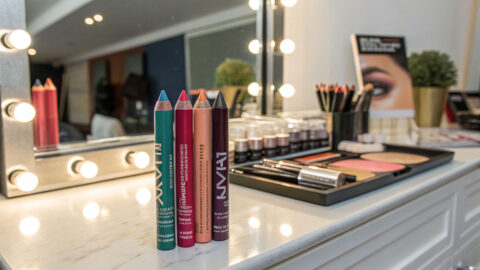
Chill the pencil first. Then turn it gently in the regular-size hole of a cosmetic sharpener and look at the point every turn or two. The Slim Lip Pencil has a buttery-soft core that smears and breaks when it’s warm, so the short stint in the cold does most of the work.
The Slim Lip Pencil, the Suede Matte Lip Liner and the Line Loud Longwear Lip Liner are the NYX liners that take a blade. The Retractable Lip Liner twists up and never needs a sharpener. A few third-party listings describe the Slim Lip Pencil the same way, which is wrong, and NYX’s own FAQ says it does not twist up.
Which NYX Lip Liners Need Sharpening?

Everything in the table below gets a sharpener except the Retractable, which you just twist.
| NYX liner | Format | Sharpen it? |
|---|---|---|
| Slim Lip Pencil | Classic pencil | Yes, with a cosmetic sharpener |
| Suede Matte Lip Liner | Classic pencil | Yes, NYX says its Double Pencil Sharpener or any cosmetic-grade sharpener works |
| Line Loud Longwear Lip Liner | Classic wood pencil | Yes, listed as a sharpenable wood pencil |
| Retractable Lip Liner | Twist-up mechanical pencil | No, just twist |
NYX’s own product copy for the Slim Lip Pencil, reproduced on iHerb, tells you to sharpen it before lining and calls the formula buttery-soft. Macy’s lists the NYX dual sharpener as a match for both the Slim Lip Pencil and the Suede Matte Lip Liner, and reviewers on Beauty Crew say the Suede Matte liners sharpen easily. An Ulta reviewer who bought the sharpener for their NYX Line Loud pencils says it works great.
The mix-up with twist-up designs comes from the Retractable, which Macy’s lists as a mechanical design with no sharpener needed. Check the barrel before you reach for the blade.
The basics of sharpening lip liner carry over to NYX. The soft core is the only part that asks for extra care.
How to Choose a Sharpener for NYX Lip Liner

Pick a cosmetic sharpener whose hole matches the pencil and whose blade is sharp. The NYX 2-in-1 dual sharpener covers both for the Slim Lip Pencil.
It has a regular-size hole for lip and eye pencils and a larger one for jumbo pencils. Steel blades and an inner casing that catches shavings come standard, and as of October 2026 Ulta lists it at $4.50.
A slim lip pencil belongs in the regular hole. The large one is for jumbo pencils, and sharpening a NYX jumbo eye pencil has its own walkthrough.
The sharpener is cheap and easy to find at retailers like Ulta, and the shavings stay in the casing. Ulta reviewers say the lid does not stay on, though, so shavings can spill, and one Macy’s reviewer says a tip takes far more than 3 to 4 turns.
A standard cosmetic sharpener works too. MasterClass describes the dual-blade design as built to keep a soft tip intact, and Temptalia readers name the MAC single and the Urban Decay Grindhouse double-barrel as favorites. Fit is a guess unless the pack says it takes slim lip pencils.
Blade condition matters more than brand. Temptalia commenters say a sharpener that catches or tears the pencil has gone dull, and the fix is a new sharpener, not more pressure.
Several of those commenters also keep one sharpener for lip pencils and another for kohl eye pencils. For most NYX owners the $4.50 sharpener is plenty, and replacing it when it dulls costs less than buying a premium one.
Why Chill a Soft Lip Liner Before Sharpening?
Cold firms the wax and oil core, so the blade shaves it instead of smearing it. Bottom Line Inc. credits style author Kim Johnson Gross with the tip of putting a soft pencil in the freezer for about 10 minutes, which keeps the tip from snapping off in the sharpener.
The Slim Lip Pencil is a good candidate. The Well.ca ingredient list pairs candelilla wax, beeswax and carnauba wax with jojoba oil, shea butter and hydrogenated coconut oil.
Warm rooms make that blend worse. A Temptalia commenter in a hot, humid climate avoids soft-formula pencils because they melt at room temperature.
Sources don’t agree on how long or how cold. Sephora Community and Temptalia commenters go with the fridge for a short while, for soft pencils that would otherwise shave away or snap. Lyko’s customer service team told a customer whose soft pencil would not fit their sharpener to use the freezer for 10 to 15 minutes. The Bottom Line Inc. tip says 10 minutes, and a Lemon8 creator post says 10 to 20 minutes, chills the sharpener as well, and goes up to 30 minutes for particularly soft pencils.
That 30 minutes is the longest time any of these sources gives. My rule: freezer for very soft shades, fridge for a pencil that is only slightly soft, and a few more minutes before you blame the tool.
Not everyone chills. One Temptalia commenter says a sharp, well-fitting sharpener handles any softness, which fits the earlier point about blades.
How to Sharpen NYX Lip Liner Step by Step

Pressure snaps a soft tip. More turns do not. Go slowly, keep the pencil in the regular-size hole and check the point as you go.
- Chill the pencil for 10 to 20 minutes, and the sharpener too if you like.
- Wipe old residue off the tip with a tissue.
- Slide the tip into the regular-size hole until it meets the blade.
- Turn clockwise with light pressure. That is the direction in the NYX sharpener directions on Beauty Bay.
- Check the point every turn or two. A worn tip can need more than 3 to 4 turns (a Macy’s reviewer), while a barely dulled one needs fewer.
- Discard the shavings, wipe the new tip once with a tissue, and test the line on the back of your hand.
If the tip keeps snapping, hold the pencil still and turn the sharpener around it instead. MasterClass recommends that switch for eyeliner pencils, and it works on a soft lip pencil for the same reason.
Once the point is ready, how you apply lip liner decides how clean the line looks. NYX’s directions say to start at the center of the lips and work toward the outer corners.
What Makes NYX Lip Liner Break While Sharpening

How the tip fails points to the cause. A clean snap, a crumbling core and a torn tip each come from a different problem.
| What happens | Likely cause | Fix |
|---|---|---|
| Point snaps off | Sharpened too far | Stop a turn earlier |
| Core crumbles or smears | Pencil too warm | Chill it again |
| Product tears, blade catches | Old residue in the sharpener | Clean the blade |
| A chunk breaks off | Dull blade | Replace the sharpener |
Over-sharpening is the cause people miss. Bodyography’s instructions for its pencil sharpener warn against going too far because the point breaks off.
Residue is the quiet one. A Sephora Community member says blobs of old liner stuck inside the sharpener cause breakage, and while that thread is about eyeliner, a creamy lip core behaves the same way.
Bustle’s beauty writer puts it plainly for creamy pencils: a dull sharpener snaps off a piece of product and wastes it.
Waste matters here because a Slim Lip Pencil holds only 1.04 g (0.03 oz) of product, according to its iHerb listing. A snapped tip takes a noticeable share of that.
After a break, chill the pencil again before the next try, then sharpen from the break instead of reshaping the whole cone.
If a chilled pencil still crumbles in a clean, sharp sharpener, the pencil is faulty. Return it.
How to Clean the Sharpener and Lip Liner Tip
Empty the shavings, then run a cotton swab dipped in isopropyl alcohol around the blade and the shavings compartment. Elizabeth Arden makeup artist Rebecca Restrepo gives that routine in a Beautylish guide, and she sanitizes her sharpener after every client.
Beautylish’s guide to sanitizing eyeliners specifies 70% rubbing alcohol for wiping the sharpener before use. The pencil itself gets cleaned by sharpening, since the outer layer shaves off, and QC Makeup Academy treats wax-based pencils like cream products for hygiene.
Restrepo’s own sharpener has lasted about a year. She bins one right away after an eye infection or a breakout near the lips.
Sources split on sanitizing makeup with sprays and wipes. Beautylish forum members spray alcohol on pencils and wipe the top layer off, while ABC7 quotes dermatologist Dr. Shirley Chi saying she probably would not use sanitizing wipes and sprays directly on powders and shadows, because makeup already contains preservatives.
Wipe the sharpener, not the pencil. One Beautylish member describes a girl who doused her liner in alcohol and applied it straight into their eye, so let any alcohol dry before the point touches skin.
Lip pencils also do better on their own sharpener. Bustle’s writer keeps hers separate to stop dark eyeliner pigment ending up in a pink liner, and the FDA warns against using lip liner as eyeliner because of mouth bacteria and color additives not approved near the eyes.
How Sharp Should the Tip Be, and How Often Should You Sharpen

Sharpen to a fine point for outlining and leave a slightly rounder one for filling. Resharpen when the line turns thick or starts to skip, since a thick or uneven line means the point is gone.
Hygiene gives a second reason. QC Makeup Academy’s rule is to always sharpen wax-based pencils so the used tip is shaved away. Professionals sharpen between clients on shared kits, and a personal pencil can wait until the line degrades.
Tip for lining
Makeup.com by L’Oreal says a sharp pencil with a precise cupid’s bow suits a bold or dark lip, while a duller point fits a soft, stained look. Makeup artist Yuki Hayashi, quoted by Glamour South Africa, pushes the other way: he says a harsh line can make bright lipstick look dated.
Both are right for different finishes. Pick the point by the look, not by habit.
NYX’s pro tip for the Suede Matte Lip Pencil is to contour just outside the natural lip line for a plumper, more sculpted pout, which a fine tip makes easy. The same crisp edge helps keep lipstick from feathering.
Tip for filling
Buxom Cosmetics’ guide sets the two uses side by side.
- An outline alone gives crisp edges and works best under gloss.
- A full fill acts as a primer, deepens pigment, cuts transfer and extends wear.
A blunter point covers more lip per stroke, so there is no reason to sharpen for filling. Filling the whole lip is also one way to make lip liner last through a long day.
NYX Lip Liner Sharpening FAQ
Can I use a regular pencil sharpener on NYX lip liner?
Only in a pinch. Makeup artist Rebecca Restrepo says a clean standard sharpener works but was not designed for cosmetics, and a graphite sharpener that has already been used on pencils should never touch a lip pencil. A cosmetic sharpener is the better buy.
Does the NYX 2-in-1 sharpener work on other brands’ pencils?
Yes. The Ulta listing says it sharpens standard sizes from other brands as well as NYX jumbo and regular pencils.
Make sure the pencil sits snugly in the regular-size hole before you turn it.
How should I store NYX lip liner in hot weather?
Keep it below 85 degrees F, the storage ceiling the FDA gives for cosmetics. One Temptalia commenter keeps soft eye pencils in a zip bag in the fridge, which also makes them easier to sharpen.
Does sharpening waste a lot of NYX lip liner?
Each pass trims some core, but most of the loss comes from breakage. A chilled pencil, a sharp blade and fewer turns keep the loss close to the shavings.
Is it safe to share a sharpener?
Avoid it. The FDA advises against sharing cosmetics, and professionals such as Restrepo sanitize their sharpener after every client.
If you must lend one, clean the blade first.
When a Retractable NYX Lip Liner Makes More Sense
If a pencil still crumbles after chilling and a fresh blade, a retractable NYX lip liner makes more sense, because that failure comes from the formula and not your technique. The cost is the tip. A twist-up liner does not reach the fine point a sharpened pencil does.
Shade range shifts the decision too. NYX’s US store lists the Retractable Lip Liner in 15 shades as of October 2026, while an iHerb listing gives the Slim Lip Pencil 31 shades.
The twist-up design has its own failure, since Macy’s reviewers report the liner sometimes breaks inside the tube. So work from the cheapest fix to the biggest change: replace the sharpener, then chill the pencil, and only then switch to the twist-up.
Shade and formula matter as much as format when choosing a lip liner.

She started writing on the site after fielding the same questions from clients and friends often enough to just write the answers down: which red won't turn orange on a warm undertone, how to keep lipstick from feathering into fine lines, why a "12-hour" formula rarely survives dinner.
Every review on the site follows the same rule she uses with paying clients: wear it first, then decide if it's worth recommending.
- How to Make Eyeliner Last Longer Without Smudging - August 31, 2026
- How to Make Eyeshadow Last Longer All Day - August 29, 2026
- How to Find Your Undertone in 5 Easy Steps - August 27, 2026